
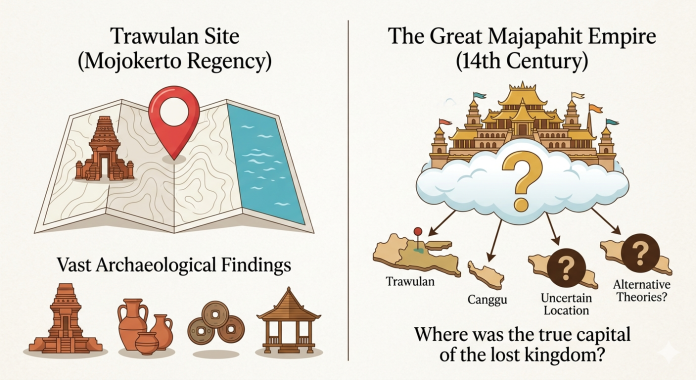

RADAR TULUNGAGUNG – The question of whether Trowulan truly served as the capital of the Majapahit Kingdom continues to spark debate among archaeologists and historians. For decades, researchers have examined artifacts, ancient texts, and excavation data, yet no one has reached a definitive conclusion about the exact location of the royal center, or kedaton.
The debate gained fresh attention after local brick craftsmen discovered ancient brick structures in Kumitir Village, Mojokerto. The structure stretches 21 meters in length, runs north to south, and consists of 14 layers of red bricks. Archaeologists quickly followed up with rescue excavations. They later uncovered a longer structure extending up to 200 meters, which likely functioned as a talut or defensive boundary for an elite settlement during Majapahit’s peak.
Archaeologists involved in the excavation confirmed that the bricks match typical Majapahit construction techniques. Builders arranged the red bricks by rubbing them together without adhesive, a method found across sites in Trowulan. These findings strengthen the argument that the area formed part of a larger urban complex connected to the empire.
Trowulan as the Center of Majapahit Civilization
Researchers have long considered Trowulan the strongest candidate for Majapahit’s capital. The site spans nearly 100 square kilometers and contains numerous historical remains that reflect a complex urban environment.
Key landmarks include Candi Brahu, Candi Tikus, and Kolam Segaran. Visitors can also explore the Trowulan Museum, which preserves many artifacts from the Majapahit period. The Indonesian government designated Trowulan as a National Cultural Heritage Site in 2013.
Aerial surveys and geographical information system (GIS) analysis reveal a network of canals and water management systems across the site. These features suggest that planners designed Trowulan as a well-organized city. The layout supports descriptions of a sophisticated royal center during Majapahit’s golden age in the 14th century.
Contradictions in Historical Records
Despite strong archaeological evidence, several inconsistencies appear in historical records. One of the most important sources, Nagarakretagama, written by Empu Prapanca in 1365, describes the royal court in detail. However, the text does not mention several major features found in Trowulan, including Kolam Segaran.
The text also omits references to city walls, even though archaeologists have identified structures that resemble fortifications. These gaps raise doubts about whether Trowulan fully matches the capital described in the manuscript.
Another key source, Pararaton, states that Raden Wijaya established Majapahit in an area called Tarik. Historians believe Tarik lay near the Brantas River delta. In contrast, Trowulan sits inland, far from the river’s current flow. This geographical mismatch adds another layer of uncertainty.
Lost Evidence and Colonial Influence
The loss of archaeological evidence has also complicated efforts to identify the true capital. Researchers estimate that Trowulan has lost millions of cubic meters of soil since the early 20th century. Looting, uncontrolled excavations, and colonial-era activities removed valuable artifacts and erased important layers of history.
Colonial scholars played a significant role in shaping the narrative. Thomas Stamford Raffles documented archaeological remains in his book History of Java. His work helped popularize the idea that Trowulan served as the Majapahit capital.
Later researchers expanded on these early observations. They produced maps and urban reconstructions that placed the royal palace east of Kolam Segaran. Over time, scholars and the public widely accepted this interpretation, even though it relied heavily on assumptions rather than conclusive proof.
An Unresolved Historical Mystery
Until now, archaeologists have not found definitive evidence that confirms Trowulan as the capital of Majapahit. Researchers continue to compare textual descriptions with material findings, but significant gaps remain.
The central question persists: if Trowulan did not serve as the royal center, where did the Majapahit rulers actually establish their capital?
For now, Trowulan remains the most convincing candidate. At the same time, it stands as a reminder that historical interpretation often evolves alongside new discoveries.