

RADAR TULUNGAGUNG – Romusha Japanese occupation Indonesia stands as one of the most tragic and often overlooked chapters in the nation’s struggle during World War II. What initially appeared as a promise of liberation quickly turned into a system of exploitation that forced thousands of Indonesians into brutal labor. Behind Japan’s early propaganda as a “protector of Asia,” a harsh reality unfolded, one marked by coercion, suffering, and broken promises.
At the height of Japan’s control in 1942, the need for manpower to support its war efforts led to the mass recruitment of Romusha, or forced laborers. Young men and farmers were taken from their homes under false pretenses or outright threats, becoming part of a massive workforce used to build strategic infrastructure. The Romusha Japanese occupation Indonesia policy not only targeted individuals but also disrupted entire communities, leaving families without providers and villages without workers.
As the system expanded, the true scale of its cruelty became undeniable. Workers were sent across regions, even overseas, under inhumane conditions, often without adequate food, wages, or medical care. The story of Romusha Japanese occupation Indonesia is not just about forced labor; it is a stark reminder of how quickly hope can be replaced by oppression, and how deeply such policies can scar a nation’s social and economic fabric.
The Arrival of Japan and Early Propaganda
Japan first entered Indonesia in the early 1940s, capitalizing on global instability during World War II. After successfully defeating Dutch colonial forces in March 1942 through the Kalijati Agreement, Japan took control of the archipelago.
At the beginning of its rule, Japan positioned itself as a “liberator” of Asian nations. It promoted the idea of being Indonesia’s “elder brother,” aiming to gain public sympathy. Many Indonesians initially welcomed this narrative, especially after centuries under Dutch colonialism.
However, this goodwill did not last long. As the war intensified, Japan shifted its focus toward exploiting Indonesia’s resources—including its people—to support its military efforts.
The Emergence of Romusha
The Romusha Japanese occupation Indonesia policy began around 1942 after Japan faced increasing pressure from Allied forces. To strengthen its defense and maintain control, Japan needed a massive labor force.
Romusha refers to forced laborers, mostly consisting of Indonesian peasants and young men. They were recruited through both persuasion and coercion. On one hand, Japanese authorities promised wages, food, and the honorable title of “economic heroes.” On the other hand, local officials were threatened to supply laborers, forcing many to comply out of fear.
Most Romusha workers were men aged between 14 and 45, physically fit, and taken from rural areas. This resulted in thousands of individuals being separated from their families.
Harsh Working Conditions and Exploitation
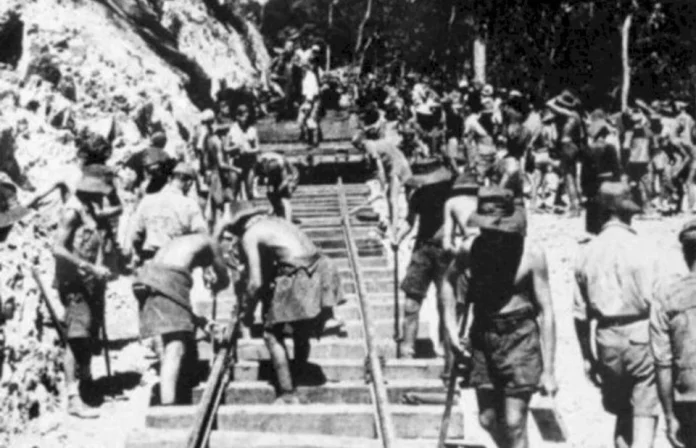
Romusha laborers were assigned to heavy infrastructure projects such as roads, railways, bridges, airstrips, and military facilities. These projects were crucial for Japan’s war logistics.
Initially, many workers were placed near their hometowns. But over time, they were transported to distant regions, even abroad, including Myanmar, Thailand, Vietnam, and Malaysia. The transportation itself was often inhumane, with workers packed tightly into closed train wagons, lacking ventilation and basic necessities.
Once they arrived, the conditions worsened. Romusha workers were forced to work long hours without proper rest, food, or medical care. Diseases such as malaria, cholera, and dysentery spread rapidly. Many died before even completing their assignments.
One of the most notorious projects was the construction of the Thailand-Myanmar railway, where thousands of Romusha lost their lives. Out of those sent overseas, only a small percentage returned home.
Broken Promises and Economic Hardship
Despite initial promises, most Romusha workers never received wages. The amount they were told, around 0.40 guilders, was already extremely low, equivalent to the price of a single banana. In reality, even that was rarely paid.
The Romusha Japanese occupation Indonesia system also had severe consequences for the broader population. Since many workers were farmers, agricultural production declined drastically. This led to food shortages and soaring prices.
As a result, many Indonesians were forced to survive on inadequate and unhealthy food, including banana stems, papaya leaves, and even snails. Malnutrition became widespread, contributing to various health problems such as beri-beri and other chronic illnesses.
Social Impact on Education and Society
The impact extended beyond the economy and health sector. Education suffered significantly. Many children had to leave school to replace their fathers or support their families. Teenagers were also directly recruited as Romusha, cutting short their education.
Schools were forced to close due to a lack of students. This caused a decline in educational quality and long-term human resource development in Indonesia.
A Painful Legacy
Although Japan’s occupation lasted only about three and a half years, the impact of the Romusha Japanese occupation Indonesia system left deep scars. Thousands of lives were lost, families were torn apart, and the nation suffered widespread hardship.
This historical episode serves as a reminder of the cruelty of forced labor and the importance of preserving independence. The suffering endured by Romusha workers continues to be remembered as a symbol of resilience and sacrifice in Indonesia’s journey toward freedom.