
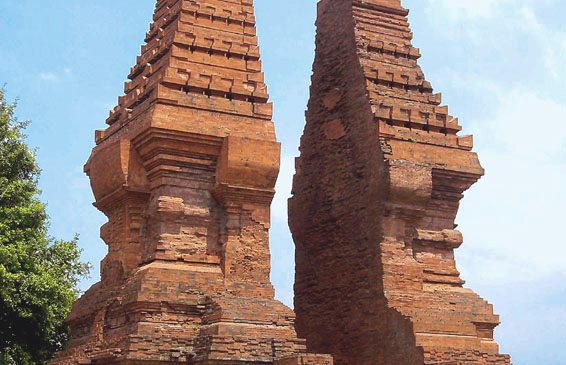

RADAR TULUNGAGUNG – The Majapahit Empire history continues to fascinate historians and readers alike, telling the story of a powerful kingdom that once dominated the Indonesian archipelago. Founded in the late 13th century, Majapahit rose from a small forest settlement into a vast empire whose influence stretched across Southeast Asia. Its journey from humble beginnings to unmatched glory, and eventual collapse, offers valuable insights into power, politics, and legacy.
In the early stages of Majapahit Empire history, the figure of Raden Wijaya played a decisive role. After the fall of the Singasari Kingdom, he sought refuge and devised a strategic plan to rebuild power. With the advice of Arya Wiraraja, Raden Wijaya approached Jayakatwang, the ruler of Kediri, and requested permission to open the Tarik forest. This forest later became the foundation of a new settlement known as Majapahit, named after the bitter maja fruit found in the area.
The Strategic Rise of Majapahit
Raden Wijaya’s political intelligence became evident when he formed an alliance with Mongol forces sent by the Yuan Dynasty to punish Kertanegara. Using this opportunity, he successfully defeated Jayakatwang. However, instead of remaining allied, Raden Wijaya turned against the Mongol troops and expelled them from Java. This bold move marked the true beginning of Majapahit’s independence and power.
Following his coronation, Majapahit steadily expanded its influence. Yet, the most significant phase in Majapahit Empire history came during the reign of Hayam Wuruk, who ruled from 1350 to 1389. Under his leadership, the kingdom entered its golden age, supported by the legendary prime minister, Gajah Mada.
The Golden Age Under Hayam Wuruk
The success of Majapahit during this era cannot be separated from Gajah Mada’s famous Sumpah Palapa (Palapa Oath). He vowed not to enjoy worldly pleasures until he unified the Nusantara under Majapahit rule. This ambition drove a series of military campaigns and diplomatic strategies that expanded Majapahit’s territory across Sumatra, Kalimantan, the Malay Peninsula, and eastern Indonesia.
Historical records, especially the Nagarakretagama manuscript written by Mpu Prapanca, highlight the vast reach of Majapahit’s power. The empire not only controlled trade routes but also established political influence over numerous regions. This period marked the peak of Majapahit Empire history, where stability, prosperity, and cultural achievements flourished simultaneously.
Internal Conflict and the Beginning of Decline
Despite its impressive achievements, Majapahit Empire history also reflects the fragility of power. After the death of Hayam Wuruk, internal conflicts began to weaken the kingdom. One of the most significant events was the Paregreg War, a civil war between Wikramawardhana and Bhre Wirabhumi.
This conflict divided the royal family and destabilized the central authority. As a result, many regions under Majapahit’s control started to break away. The weakening of political unity significantly reduced the empire’s ability to maintain its dominance.
External factors also contributed to the decline. The rising influence of the Ming Dynasty in China shifted regional power dynamics, while local rebellions further eroded Majapahit’s control. Combined with possible natural disasters and economic challenges, these issues accelerated the fall of the once-great empire.
Cultural Legacy That Endures
Although Majapahit eventually collapsed, its legacy remains deeply embedded in Indonesian culture. Numerous temples serve as silent witnesses to its grandeur. Sites such as Penataran Temple in Blitar, Tikus Temple in Mojokerto, and Sukuh Temple in Central Java reflect the architectural brilliance of the era.
In addition to physical structures, literary works also preserve Majapahit’s history. The Nagarakretagama stands out as a crucial historical source, detailing the kingdom’s territories and royal journeys. Inscriptions like the Waringin Pitu inscription provide further insights into governance and administration during that time.
Majapahit Empire history is more than just a tale of conquest and power. It represents a significant chapter in Indonesia’s past, illustrating how strategic leadership, unity, and ambition can build a great civilization, while internal division can ultimately lead to its downfall.