
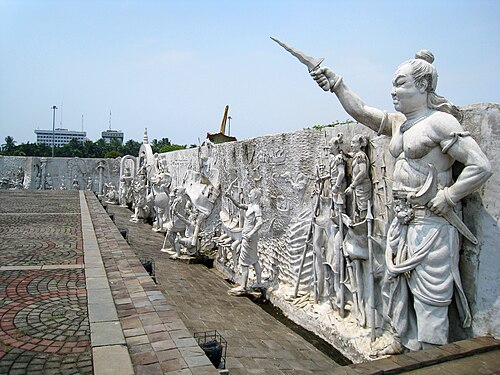

RADAR TULUNGAGUNG – The mystery surrounding Gajah Mada origins continues to intrigue historians and the public alike. Known as the powerful Mahapatih of the Majapahit Empire and the mastermind behind the famous Palapa Oath, Gajah Mada remains one of the most influential figures in Indonesian history. However, despite his prominence, the question of where Gajah Mada actually came from is still unresolved.
The debate over Gajah Mada origins has sparked numerous claims from different regions, both within and outside Java. Some narratives even suggest mythical beginnings, ranging from divine ancestry to supernatural birth stories. But what do historical sources really say?
Primary Sources Reveal Limited Facts
To understand Gajah Mada origins, historians rely heavily on primary sources such as inscriptions from the Majapahit era. These include the Singhasari Inscription, Walandit Inscription, and Prapancasarapura Inscription. While these documents confirm Gajah Mada’s existence and role as “Mapatih” (prime minister), they do not provide any information about his birth or family background.
This absence is not unusual. In ancient Javanese culture, inscriptions were primarily used to record royal decrees rather than personal biographies. As a result, figures like Gajah Mada are mentioned only in relation to their duties and achievements, not their origins.
Interestingly, these inscriptions highlight the expansion of Gajah Mada’s authority. Initially referred to as “Mapatih ri Majapahit,” his title later evolved into “Mapatih ri Yawadwipamandala,” indicating broader control over Java and surrounding regions. This suggests a significant rise in political influence, reinforcing his reputation as a key architect of Majapahit’s power.
Literary Sources Add Context, Not Clarity
Beyond inscriptions, literary works such as Negarakertagama and Pararaton also mention Gajah Mada. Negarakertagama, written in 1365, is considered a primary source because it was composed shortly after his death. However, like inscriptions, it focuses on his achievements rather than his origins.
Pararaton, a later text, provides additional narratives but still does not reveal where Gajah Mada was born. Other works, including Babad Tanah Jawi, Hikayat Hang Tuah, and Balinese chronicles, mention him but often mix history with mythology.
Some of these texts even present fantastical stories, such as Gajah Mada being born from a coconut or as the son of a god. Historians widely regard these accounts as symbolic rather than factual, reflecting the tendency to elevate great figures through myth.
Historians Offer Competing Theories
Due to the lack of concrete evidence, modern historians have proposed several theories about Gajah Mada origins. One prominent analysis suggests he came from Pandaan, East Java. This theory is based on connections to figures like Gajah Pagon and the rapid rise of Gajah Mada’s political career, which may indicate ties to influential circles.
Another hypothesis proposes that he was related to King Kertanegara, based on his involvement in constructing a religious monument linked to the king. A third theory points to Bedander as his possible hometown, arguing that Gajah Mada brought King Jayanegara there during a crisis because it was a place he knew well.
However, all these theories remain speculative. None are supported by definitive historical records.
Myth vs Historical Reality
The lack of clear data has led to widespread speculation, including claims that Gajah Mada was Malay or from other regions. These arguments often rely on weak assumptions, such as the presence of elephants in Sumatra or loosely connected historical events.
In contrast, the strongest hypothesis places Gajah Mada within the Javanese cultural sphere, supported by the geographical context of Majapahit and related historical texts. Still, without direct evidence, even this conclusion remains tentative.
Cultural Perspective on Identity
The mystery of Gajah Mada origins may also reflect a broader cultural perspective. In ancient Java, a person’s background was less important than their achievements. Historical records prioritized actions, contributions, and legacy rather than lineage or birthplace.
This explains why even kings rarely had their birth recorded. Notably, only Hayam Wuruk’s birth is documented, and that too because it was associated with significant natural events considered symbolic.
Conclusion
Ultimately, the true origins of Gajah Mada remain unknown. Primary sources confirm his role and greatness but remain silent on his birth. Secondary sources and myths attempt to fill the gap, but they often blur the line between fact and fiction.
What stands out is not where Gajah Mada came from, but what he accomplished. His legacy as a unifier of the archipelago continues to define his place in history, proving that actions, not origins, are what truly endure.