
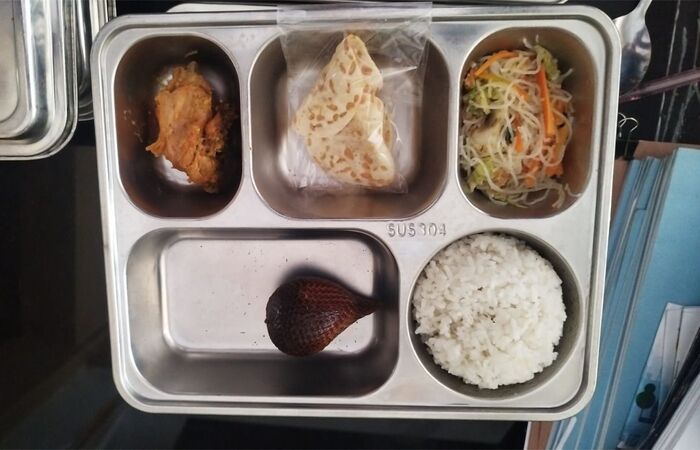

RADAR TRENGGALEK – Health authorities moved quickly to safeguard the Free Nutritious Meal Program (MBG) in Trenggalek after reports surfaced of foul-smelling food delivered to a local elementary school. Initial laboratory tests confirmed that the samples contained no E. coli bacteria, officials said.
Parents first raised concerns on Thursday (Feb. 5) when nearly 400 meal portions arrived at SD Inovatif Muhammadiyah 1 Trenggalek with a strong odor. The meals came from the Nutritional Fulfillment Service Unit (SPPG) Ngantru 3.
After receiving complaints, the Trenggalek Health, Population Control, and Family Planning Agency (Dinkesdalduk KB) sent its monitoring team directly to the kitchen facility. At the time, kitchen staff were preparing a second cooking session.
Inspectors reviewed food handling procedures and identified several issues that required attention. As a precaution, the agency instructed the kitchen to stop preparing the affected menu.
“We received a report from parents and immediately inspected the SPPG Ngantru 3 location,” said Sunarto, head of Dinkesdalduk KB Trenggalek.
Officials also told the operator to pull back meals that had already reached the school. According to Sunarto, the team detected an unusual odor in the food samples collected on site.
The agency then transported the samples to the Regional Health Laboratory (Labkesda) in Trenggalek for bacteriological analysis. Technicians first cultured the samples before conducting the examination.
The lab confirmed that the food tested negative for Escherichia coli (E. coli). Nevertheless, Sunarto stressed that this result does not automatically guarantee complete safety.
“A negative E. coli finding does not eliminate the possibility of other bacteria such as Staphylococcus, Shigella, or Salmonella,” he explained.
Should students report symptoms after consuming the meals, the agency will conduct further testing at a referral laboratory in Surabaya that has more advanced equipment.
During the inspection, officials traced the odor to raw chicken that may not have been fresh. The kitchen staff acknowledged that the chicken quality differed from usual supplies.
“The smell was already unpleasant and slightly fishy. Based on the cook’s explanation, the chicken was not as fresh as usual. That likely caused the issue,” Sunarto said.
Beyond testing, the health agency immediately provided guidance to kitchen managers. Officials emphasized strict standards for raw material selection, storage systems, and sanitation practices.
They also instructed staff to separate raw and cooked ingredients to avoid cross-contamination. Through these steps, the agency aims to strengthen food safety controls and protect the credibility of the Free Nutritious Meal Program in Trenggalek.