
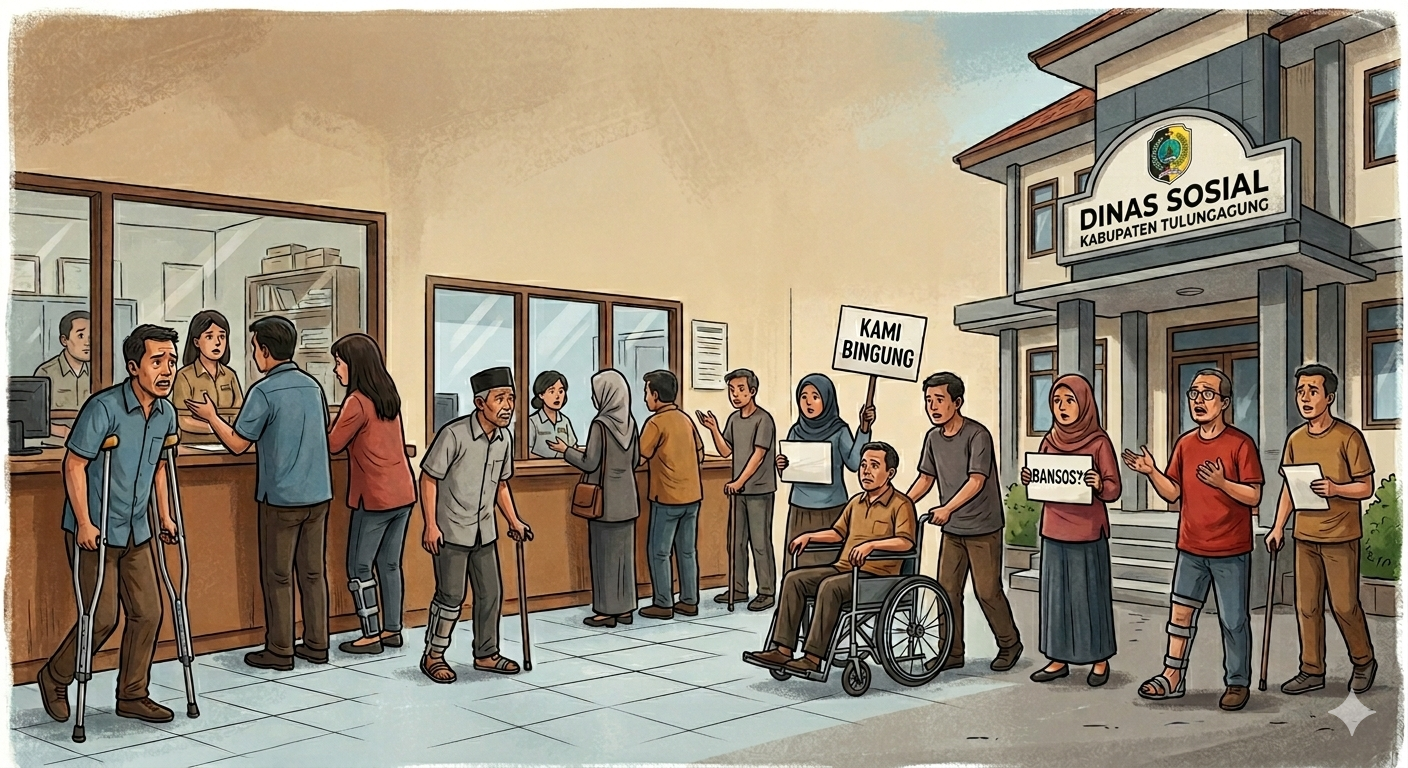

TULUNGAGUNG – Social aid suspension in Tulungagung has sparked protests after dozens of disabled residents suddenly stopped receiving government assistance.
On Monday (March 2), members of the disability community went to the Social Affairs Office in Tulungagung, East Java. They sought clarification after payments under the Program Keluarga Harapan (PKH) and Bantuan Pangan Non Tunai (BPNT) failed to arrive for several months.
According to Didik Prayitno, head of the Persatuan Cacat Tubuh Tulungagung (Percatu), many members had depended on the aid for years. However, the payments abruptly stopped without prior explanation.
“Some members have missed payments for months. Meanwhile, others have waited nearly a year,” Didik said.
Previously, most affected residents received around Rp 300,000 per month through PKH, distributed every quarter. Therefore, the sudden halt has created financial uncertainty. Didik emphasized that the government categorizes people with disabilities as a priority group.
“That is why we were shocked when the funds suddenly stopped,” he added.
However, the group suspects the issue goes beyond technical delays. They believe recent changes in poverty decile classifications triggered the suspension.
In Indonesia’s social welfare system, authorities rank households from decile 1 to 10 based on socioeconomic data. Lower deciles receive priority assistance. When the system moves someone to a higher decile, that person may lose eligibility.
Didik said several members saw their decile status rise in 2026. Nevertheless, none of them recall any survey or field verification.
“Friends suddenly saw their decile increase. Yet no one conducted a survey,” he said.
Fahmi Alif Aldianto, head of social protection at the Tulungagung Social Affairs Office, offered a different explanation. According to him, various administrative and data-update issues caused the disruption.
For instance, some beneficiaries faced banking problems. In addition, others had not secured a Family Welfare Card (KKS). The central database placed several individuals in decile categories that no longer qualify for aid.
“There are multiple factors behind this,” Fahmi said.
Initial checks showed two residents encountered account or KKS issues. Meanwhile, four others remain in deciles 1 to 4. They must resubmit their data through village or urban ward offices. As a result, they must wait for the verification process.
On the other hand, six individuals now fall within deciles 6 to 10. The system no longer prioritizes them for assistance.
Fahmi stressed that the central government controls decile classifications. Local offices can only propose updates rather than make direct changes. Once villages submit revisions, authorities typically process them within three months.
In addition, officials deactivated one beneficiary after detecting suspected misuse of funds. The individual can file an objection through the Social Welfare Information System Next Generation (SIKS-NG) or the Ministry of Social Affairs’ Cek Bansos application.
“If the data does not reflect real conditions, residents should request an update through their village office. We will facilitate the process,” Fahmi said.
The Social Affairs Office hopes residents will resolve the dispute through official mechanisms. However, disability advocates argue that vulnerable communities need clearer communication and stronger safeguards.
For many families, this social aid suspension represents more than a technical adjustment. Instead, it directly affects their daily survival and economic stability.