
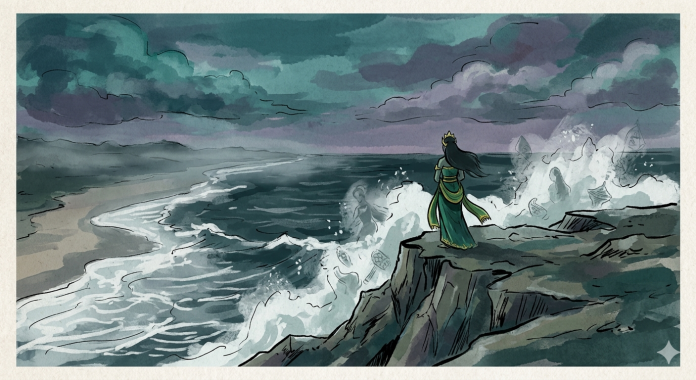

RADAR TULUNGAGUNG – The legend of Nyi Roro Kidul continues to fascinate millions of Indonesians, especially people living along Java’s southern coastline. Stories about the mystical ruler of the South Sea have survived for centuries and remain one of the most talked-about supernatural myths in Indonesian culture.
The mystery surrounding Nyi Roro Kidul recently resurfaced after a popular YouTube horror storyteller discussed various legends, theories, and eyewitness testimonies connected to the Queen of the Southern Sea. The discussion immediately attracted attention because many Indonesians still believe the mystical ruler guards the dangerous southern waters of Java.
For generations, communities in Java, Sunda, and Bali have known the legend of the South Sea Queen. However, many people still misunderstand the difference between Kanjeng Ratu Kidul and Nyi Roro Kidul. According to Javanese mythology, the two figures are not exactly the same person, although they are often linked together in popular culture.
The Difference Between Kanjeng Ratu Kidul and Nyi Roro Kidul
Traditional belief describes Kanjeng Ratu Kidul as a sacred spiritual queen who rules the Southern Ocean. Many people believe she possesses immense supernatural power and maintains spiritual ties with the royal courts of Yogyakarta and Surakarta.
Ancient Javanese traditions also claim that several Mataram kings sought spiritual guidance from the South Sea Queen. Even today, local communities still hold ritual offerings at beaches such as Parangkusumo in Bantul and Parangtritis in Yogyakarta to honor the mystical ruler.
Meanwhile, folklore portrays Nyi Roro Kidul as the loyal servant and commander of Kanjeng Ratu Kidul. Legends describe her as a beautiful woman who leads spiritual armies along the southern coast.
The Origins of the South Sea Queen Legend
Historians and cultural researchers believe the legend existed long before the Islamic Mataram Kingdom rose to power. Some anthropologists argue ancient animistic beliefs inspired the myth because coastal communities feared the violent waves and deadly storms of the Indian Ocean.
Several origin stories also appear in local folklore. One of the most famous versions identifies Nyi Roro Kidul as Dewi Kandita, a beautiful Sundanese princess who suffered after palace rivals attacked her with black magic.
According to the legend, the curse caused a terrible skin disease that made Dewi Kandita lose her confidence. She wandered alone for days until she reached the southern sea. A mysterious voice then instructed her to jump into the ocean. After entering the water, her illness disappeared completely, and she transformed into the powerful spiritual ruler known as Nyi Roro Kidul.
Other stories connect the South Sea Queen to myths involving Dewi Nawang Wulan, Aurora, and even Batak folklore about a woman named Biding Laut. Although each story offers different details, almost every version tells the story of a woman who gains supernatural authority over the Southern Ocean.
The Green Clothing Myth
One of the most famous beliefs surrounding Nyi Roro Kidul involves the prohibition against wearing green clothing near the southern beaches of Java.
Local communities believe green represents the favorite color of the South Sea Queen. Many people fear visitors who wear green clothes may attract supernatural attention and disappear into the ocean to serve the mystical kingdom beneath the waves.
Some observers, however, offer a more rational explanation. The waters along the southern coast often appear greenish, making rescue teams struggle to locate drowning victims who wear similar colors.
Despite the logical explanation, the myth still influences many tourists who visit beaches such as Parangtritis and Pelabuhan Ratu.
Places Believed to Connect With Nyi Roro Kidul
Several locations in Indonesia are strongly associated with the South Sea Queen legend.
Parangtritis Beach in Yogyakarta is widely considered the main gateway to the mystical kingdom. Every Suro night, some locals still perform traditional rituals and place offerings near the shoreline.
Another famous location is Room 308 at Hotel Inna Samudera Beach in Pelabuhan Ratu, Sukabumi. The room is believed to be specially prepared for Nyi Roro Kidul and has become a popular destination for visitors seeking mystical experiences.
Other places connected to the legend include Karang Hawu Beach in Sukabumi, Panggung Sanggabuwana in Surakarta Palace, and Sembukan Beach in Wonogiri.
Eyewitness Stories Continue to Spread
The mystery grows stronger because several individuals claim they have personally encountered the South Sea Queen.
A spiritual caretaker from Watu Ulo Beach in Jember once said he saw a beautiful woman dressed entirely in green during a 41-day spiritual meditation ritual. Another woman from Banyuwangi claimed she met a royal-looking figure wearing traditional Javanese attire with an elegant white shawl.
One of the most well-known stories came from the daughter of famous Indonesian painter Basuki Abdullah. She recalled meeting a mysterious woman wearing green while staying at the Samudera Beach Hotel decades ago. Her father later believed the figure was Nyi Roro Kidul herself.
Although no scientific evidence supports these stories, the legend of Nyi Roro Kidul remains alive through oral tradition, cultural rituals, and supernatural testimonies passed down from generation to generation.