
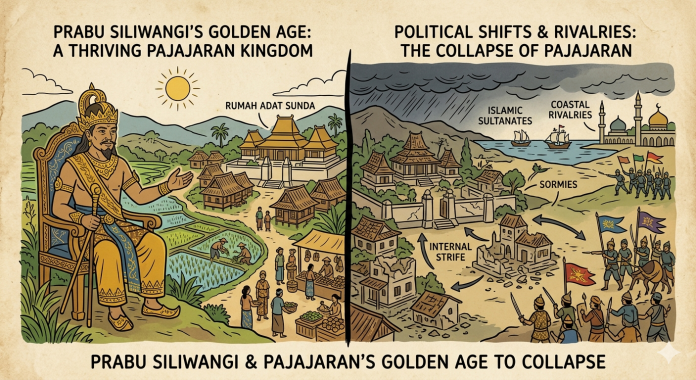

RADAR TULUNGAGUNG – Prabu Siliwangi, the legendary ruler widely associated with the golden age of the Kingdom of Pajajaran, remains one of the most influential figures in Sundanese history centuries after his death. Historians generally identify him as Sri Baduga Maharaja, a ruler who unified territories in western Java and transformed Pajajaran into a powerful political, economic, and cultural center during the late 15th and early 16th centuries.
Although Prabu Siliwangi is surrounded by myths portraying him as a mystical figure linked to the white tiger symbol of Sunda, historical records primarily describe him as Sri Baduga Maharaja, also known as Jaya Dewata. His reign marked a crucial period when the Sunda region experienced major growth in agriculture, trade, administration, and urban development.
The legacy of Prabu Siliwangi continues to attract attention because his story reflects both the height of Pajajaran’s prosperity and the beginning of the kingdom’s eventual decline amid political and religious changes along Java’s northern coast.
Sri Baduga Maharaja and the Rise of Pajajaran
Historical sources place Sri Baduga Maharaja’s birth in the early 15th century in Kawali, now part of Ciamis in West Java. He was the son of Prabu Dewa Niskala of the Galuh Kingdom and the grandson of Wastu Kancana, a respected ruler credited with previously uniting Sunda and Galuh.
Unlike many royal heirs of his era, Sri Baduga reportedly spent much of his youth interacting directly with ordinary citizens. Sundanese chronicles describe him as a disciplined leader who learned governance by overseeing the small region of Sindang Kasih in present-day Ciamis.
His reputation as a capable and approachable leader expanded through his frequent visits to Caruban Larang, now known as Cirebon. There he met Subang Larang, whom he later married. The couple had three children: Walangsungsang, Rara Santang, and Kian Santang, all of whom later became important figures in Sundanese and Islamic history.
After the death of Prabu Dewa Niskala in 1482, Sri Baduga inherited Galuh and later assumed control of Sunda, reunifying the two kingdoms under the name Pajajaran. The kingdom’s territory stretched across much of present-day West Java, from Banten to Ciamis.
The title “Prabu Siliwangi” emerged during this period. Historians believe the name derived from “silih wewangi,” meaning “successor to the fragrant king,” referring to his continuation of Wastu Kancana’s respected legacy.
Pajajaran’s Golden Age Under Prabu Siliwangi
Under Prabu Siliwangi’s leadership, Pajajaran entered what many historians consider its golden age. He strengthened irrigation systems, improved agricultural production, expanded infrastructure, and reorganized royal administration across the kingdom.
One notable development involved the construction of Sanghyang Talaga Renna, an artificial reservoir intended to stabilize water supplies and reduce the impact of seasonal floods on rice cultivation. Agriculture became the backbone of Pajajaran’s prosperity during this era.
Prabu Siliwangi also modernized Pakuan, the kingdom’s capital located in present-day Bogor. Roads, defensive structures, and government facilities expanded rapidly as the city grew into a major regional center.
Historical estimates suggest Pakuan’s population may have reached around 50,000 residents during the 16th century, making it one of the largest urban centers in the archipelago after Demak. Trade routes connected Pajajaran to merchants from Sumatra, Java, and even Gujarat in India.
The kingdom’s coastal regions, particularly Banten and Sunda Kelapa, became major trading hubs exporting pepper, rice, and forest products. These commercial activities strengthened Pajajaran’s economy and increased its regional influence.
Internal Divisions and the Fall of Pajajaran
Despite its prosperity, Pajajaran gradually faced internal and external challenges that weakened the kingdom. The rise of Islamic trading ports along the northern coast, particularly Cirebon and Banten, shifted economic and political influence away from the royal capital.
Walangsungsang and Rara Santang, children of Prabu Siliwangi and Subang Larang, became closely connected to the development of Cirebon. Rara Santang’s son, Syarif Hidayatullah, later known as Sunan Gunung Jati, emerged as one of the most influential Islamic figures in Java and a member of the Wali Songo.
As Cirebon and Banten expanded independently, Pajajaran struggled to maintain control over coastal trade networks. Historians note that Prabu Siliwangi attempted to preserve unity by avoiding direct conflict with his own descendants.
During this period, Pajajaran also established diplomatic relations with the Portuguese. In 1522, the Sunda-Portuguese treaty allowed the Portuguese to build a trading post in Sunda Kelapa in exchange for military assistance. Historians confirm that the agreement was symbolized by a stone monument known as a padrao.
However, Portuguese support never fully materialized. Meanwhile, pressure from rising Islamic powers along the coast continued to intensify.
Prabu Siliwangi is believed to have died in the 1520s at around 60 years old. After his death, Pajajaran weakened further under successive rulers, including Surawisesa. The kingdom eventually collapsed in the late 16th century as attacks from Banten intensified and Pakuan was abandoned.
Despite the fall of Pajajaran, Prabu Siliwangi’s legacy remains deeply embedded in Sundanese identity. Historical sites such as the Batutulis inscription in Bogor continue to preserve records associated with Sri Baduga Maharaja and the kingdom he helped bring to its greatest height.