

BLITAR – The historic Pesanggrahan Djojodigdo in Blitar is drawing renewed attention as a cultural site rich in history, myth, and untold stories of influential figures.
Located on Melati Street in Blitar City, the old residence once belonged to Raden Ngabehi Bawadiman Djojodigdo, a prominent official who served as Patih during the leadership of Regent Kanjeng Pangeran Haryo Warsokoesoemo. Despite its historical value, many locals remain unaware of its significance.
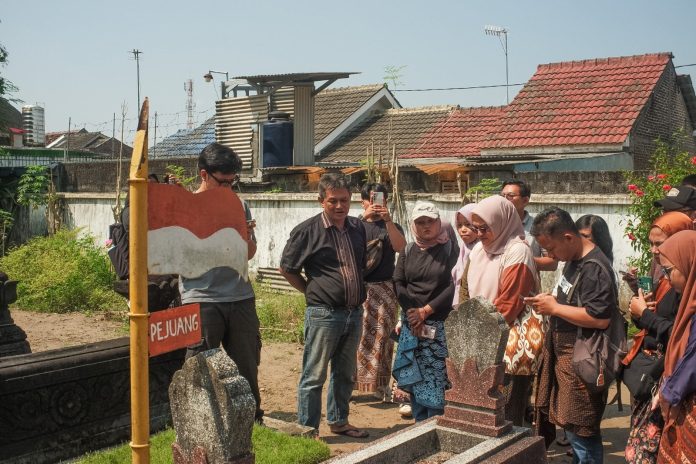
The Gang-gangan community visited Pesanggrahan Djojodigdo to explore its past. They walked from Anggrek Street and reached the site in under 10 minutes. Handoyo, a fourth-generation descendant, welcomed them with his family.
During the visit, Handoyo guided the group to a nearby family cemetery, known for the so-called “hanging grave” of Djojodigdo. The site has long been associated with mystical stories circulating among residents.
Handoyo dismissed these claims. “The stories about the hanging grave are simply folklore and myths. You can see the structure of the tomb, which is unique but not supernatural,” he explained.
The tomb, located at the western edge of the family cemetery, stands out with its white design and enclosed structure. Above it sits a small chamber believed to store personal belongings of Djojodigdo, including clothing that is more than a century old.
Handoyo recalled seeing the garments as a child. He said they remained well-presederved despite their age. The group then offered prayers at the site, reflecting local traditions of respect for ancestors.
In addition, Handoyo shared lesser-known historical connections. “Not many people know that Djojodigdo was the father-in-law of Raden Ajeng Kartini. However, they never met, as Kartini passed away a year after her marriage,” he said.
The visit continued to another grave within the same complex, belonging to Dr. Tjipto Gondoamidjojo. He was a military doctor during the Japanese occupation and reportedly accompanied Sukarno during Indonesia’s proclamation of independence in 1945.
Handoyo said efforts are now underway to propose Dr. Tjipto as a national hero. “We hope he can receive the national hero title. His contributions to the country were significant,” he added, noting that the figure recently received a state honor.
After exploring the cemetery, which contains nearly 200 family graves, the group returned to Pesanggrahan Djojodigdo to view its collection of antiques.
Inside the house, Handoyo displayed rare Dutch-language books that are over a century old. He also showed preserved traditional clothing once worn by Djojodigdo, offering a glimpse into the lifestyle of Javanese nobility during that era.
Today, Pesanggrahan Djojodigdo stands not only as a historical residence but also as a cultural landmark that connects local heritage, national history, and enduring community narratives.