
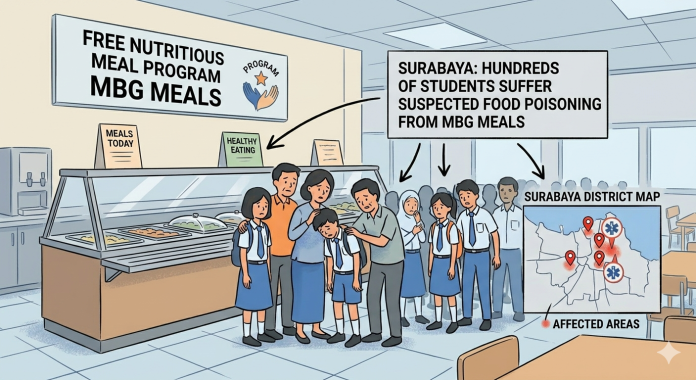

RADAR TULUNGAGUNG – A suspected mass food poisoning incident linked to the Free Nutritious Meal Program, widely known as MBG, has alarmed residents in Surabaya after hundreds of elementary and junior high school students reportedly suffered nausea and vomiting shortly after eating the meals distributed at their schools.
The Free Nutritious Meal Program became the center of public attention after students from several schools were rushed to emergency rooms and health centers across the city. Most of the victims complained of similar symptoms, including dizziness, nausea, and repeated vomiting.
Hundreds of students from elementary schools, kindergartens, and junior high schools were referred to hospitals after consuming meals prepared by the Nutrition Fulfillment Service Unit or SPPG in Tembok Duku, Surabaya. The incident immediately sparked concerns about food safety standards in the government-backed nutrition initiative.
According to medical staff and local health authorities, the number of affected students reached nearly 200. Many of them initially received treatment at local health clinics before dozens were transferred to the Mother and Child Hospital IBI Surabaya for further observation.
Hundreds of Students Suffer Nausea and Vomiting
Teachers and parents accompanied students during treatment while doctors and nurses worked to stabilize their conditions. Many students reportedly experienced symptoms shortly after eating the free meal packages distributed at school.
Officials from Tembok Duku Public Health Center confirmed that victims came from multiple schools in the area. Most students experienced nausea, vomiting, dizziness, and headaches.
Health workers successfully treated many of the students, but around 100 students still needed hospital observation because their symptoms worsened.
The shocking incident raised serious questions about how workers handled and prepared food distributed through the MBG program. Parents also expressed concern about the safety of meals served to children because the program targets students across Indonesia.
Beef Dish Becomes Main Focus of Investigation
Investigators suspect the beef dish served as the main menu caused the food poisoning incident. Officials from the SPPG Tembok Duku kitchen stated that suppliers delivered the meat in good condition.
However, they admitted that meat products carry high risks if workers fail to follow proper processing and distribution procedures.
Representatives from the nutrition service unit publicly apologized to students, parents, teachers, and schools affected by the incident. They also promised to pay all medical expenses and cooperate fully with authorities during the investigation.
The management stressed that they would take full responsibility for students affected by the suspected food poisoning case.
Authorities Temporarily Close MBG Kitchen
The East Java regional office of the National Nutrition Agency or BGN immediately closed the SPPG Tembok Duku kitchen facility after the number of victims continued to increase. Authorities said they would keep the kitchen closed until investigators completed a full evaluation.
Officials are currently examining whether food preparation, storage conditions, or distribution methods triggered the incident.
Investigation teams also collected samples from the MBG meal packages consumed by students. Laboratory staff will examine the samples to determine the exact source of contamination.
Investigators expect laboratory results to reveal whether bacteria, improper cooking techniques, or hygiene violations caused the mass poisoning incident.
Public Urges Government to Strengthen Supervision
The food poisoning incident increased public scrutiny of the Free Nutritious Meal Program, which the government introduced to improve children’s nutrition and support student health. Although many parents support the program, the Surabaya incident highlights the importance of strict quality control and hygiene monitoring.
Education observers and health experts urged authorities to strengthen supervision of food suppliers, kitchen operations, and meal distribution systems to prevent similar incidents in the future.
The case also highlights the major challenges of managing large-scale school meal programs, especially when providers distribute food to thousands of students every day.
As investigators continue examining the case, parents across Surabaya hope authorities can identify the exact cause quickly and ensure students recover without long-term health complications.