
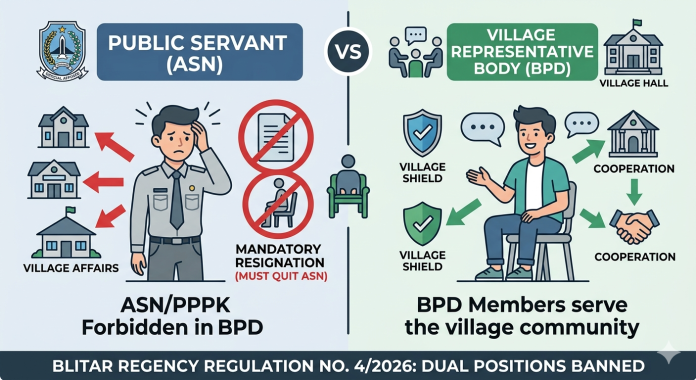

BLITAR – The Indonesia civil servants village council ban has taken effect in Blitar Regency, as local authorities enforce a new rule that bars government employees from serving in village consultative bodies (BPD).
The policy comes from Regional Regulation No. 4 of 2026, which updates earlier rules. Officials say the change aims to prevent conflicts of interest and keep civil servants focused on their main duties.
Head of the Blitar Human Resources Agency, Achmad Budi Hartawan, confirmed that the rule applies to all state employees. It covers both permanent civil servants (PNS) and contract staff (PPPK).
Officials uncovered the issue during coordination meetings with the village empowerment office. They found that many civil servants also serve as BPD members in several villages.
“We found many civil servants serving in BPD. Even though BPD is not part of village administration, they still cannot hold positions in village institutions,” he said.
Earlier regulations allowed civil servants to join BPD. However, the new rule sets a stricter requirement. Civil servants must resign if they want to serve as BPD members.
The government passed the regulation in March 2026 and has begun early implementation. Authorities still need to expand outreach so all institutions understand the rule.
At the same time, officials allow current BPD members to finish their terms if they held the role before the rule took effect. This policy ensures a smooth transition without disrupting village governance.
“If they already serve when the rule starts, they may complete their term. But if they run again, they must resign,” Budi said.
Officials have not finalized the total number of affected staff, but early findings suggest the figure is significant. The government plans to collect more data in the near future.
Authorities also warn of disciplinary action for violations. They will assess each case based on its impact on performance and public service.
Looking ahead, the government plans to strengthen outreach and coordination. Officials want every agency and village to understand and follow the regulation.
“We will continue to inform all parties. If dual roles disrupt performance, we will impose sanctions under existing rules,” Budi said.
Officials believe the policy will improve accountability and strengthen professionalism in public service. They expect the rule to support better governance across the region.