
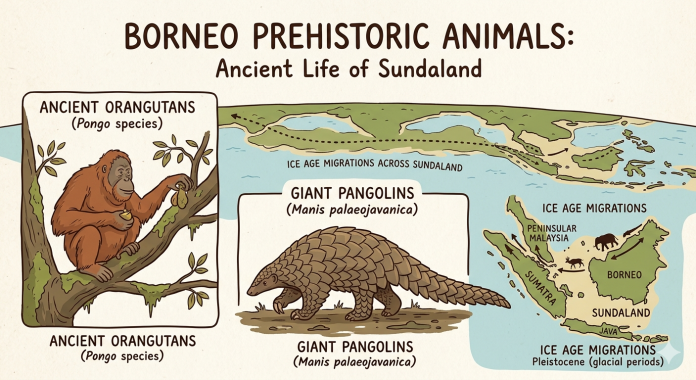

RADAR TULUNGAGUNG – Borneo prehistoric animals once inhabited a vast Ice Age landscape that connected present-day Kalimantan with mainland Asia, according to geological and fossil research that continues to reshape scientists’ understanding of Southeast Asia’s ancient ecosystems. Studies of fossils, cave records, and DNA evidence suggest the island once hosted giant mammals, prehistoric orangutans, and marine predators in environments dramatically different from modern Borneo.
Today, Kalimantan forms the Indonesian portion of Borneo, the world’s third-largest island after Greenland and New Guinea. The island contains one of Earth’s oldest continuously existing tropical rainforest regions and supports exceptionally high biodiversity, including many endemic species found nowhere else on the planet.
Researchers say Borneo’s geological history explains much of its unusual wildlife diversity. During the Ice Age, lower sea levels exposed a massive landmass known as Sundaland, connecting Borneo, Sumatra, Java, and mainland Asia through broad plains and river systems. These land bridges allowed animals and early humans to migrate freely across what is now maritime Southeast Asia.
Geological History Shaped Ancient Kalimantan
Geologists believe parts of Borneo originated from continental fragments associated with the ancient supercontinent Gondwana millions of years ago. Over long geological periods, these fragments drifted northward before eventually merging with Southeast Asia.
Evidence of this history remains visible across Kalimantan today. Limestone formations and karst landscapes in eastern and central Borneo contain marine fossils and coral-derived deposits, showing that portions of the region were once submerged beneath shallow tropical seas.
Unlike Java and Sumatra, Kalimantan later became part of a relatively stable section of Sundaland. As a result, the island developed far fewer active volcanoes than other major Indonesian islands located along the Pacific Ring of Fire.
Scientists also note that ancient river systems once crossed Sundaland during periods of lower sea levels. Freshwater fish species shared between Sumatra and Borneo, including arwana and jelawat, support the theory that interconnected river networks existed before rising seas separated the islands roughly 11,000 years ago at the end of the last Ice Age.
Prehistoric Orangutans and Giant Pangolins
Many mammals found in Borneo today belong to animal groups that originally dispersed from mainland Asia. These include deer, wild cattle, primates, and various carnivorous mammals.
One of the best-known examples is the orangutan. Fossil evidence indicates ancient relatives of modern orangutans once ranged widely across southern China and mainland Southeast Asia before populations gradually declined. Scientists identified an extinct species known as Pongo weidenreichi from fossil remains discovered in southern China dating to the Pleistocene era.
Researchers believe orangutans expanded southward into Sundaland during colder climatic periods when forests spread across exposed land bridges. As sea levels rose after the Ice Age, surviving orangutan populations became isolated mainly in Borneo and Sumatra, where the species still exists today.
Another remarkable prehistoric mammal linked to Borneo is the extinct giant pangolin Manis paleojavanica. Fossils discovered in Java and Sarawak suggest the species was significantly larger than modern Southeast Asian pangolins. Scientists estimate the animal may have reached several meters in length and weighed far more than living pangolin species.
Researchers first described the species in 1907 using fossil remains collected by Dutch paleontologist Eugène Dubois. Additional discoveries in Niah Cave, Sarawak, provided evidence that giant pangolins survived in parts of Borneo during the Late Pleistocene.
Megalodon Fossils and Early Human Migration
Northern Borneo has also produced evidence of ancient marine ecosystems. Paleontologists studying fossilized shark teeth in Brunei and other parts of Southeast Asia identified remains belonging to Otodus megalodon, the extinct giant shark species that dominated oceans millions of years ago.
Analysis of several fossil teeth suggests juvenile megalodons may have used shallow coastal waters near ancient Borneo as nursery habitats during the late Miocene and early Pliocene epochs. Adult megalodons could exceed 15 meters in length, making them among the largest predators ever known.
Archaeological evidence further shows that humans reached Borneo at least 40,000 to 50,000 years ago. Excavations at Niah Cave in Sarawak uncovered stone tools, animal remains, and signs of controlled fire associated with early modern human populations.
Researchers believe these ancient groups migrated through Sundaland from mainland Asia during periods when lower sea levels created land connections across the region. Over thousands of years, multiple waves of migration contributed to the genetic and cultural diversity of modern Southeast Asian populations.
Despite its deep prehistoric history, Kalimantan’s ecosystem now faces increasing environmental pressure. Deforestation linked to logging, mining, and palm oil expansion has accelerated since the late 20th century, threatening endangered wildlife such as orangutans and fragmenting some of the world’s oldest tropical rainforest habitats.
Scientists warn that continued habitat destruction could erase ecosystems that preserve important clues about Southeast Asia’s prehistoric past and the evolution of species that survived dramatic climatic changes over millions of years.