
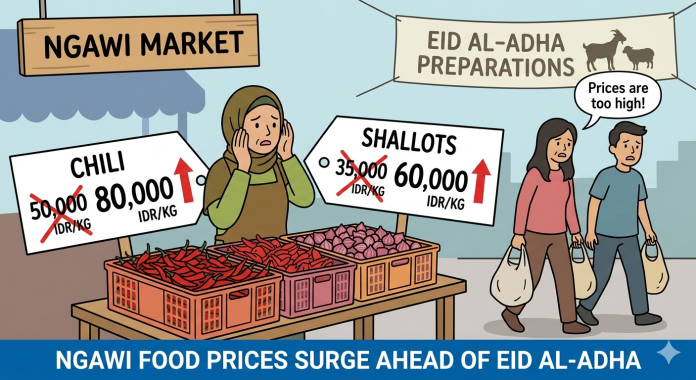

RADAR TULUNGAGUNG – A sharp rise in food prices in Ngawi Regency ahead of Eid al-Adha has sparked concern among traders and consumers, with chili and shallot prices soaring dramatically over the past week due to declining supplies from farmers and distributors. The surge has weakened consumer purchasing power and reduced sales at traditional markets.
At Pasar Besar Ngawi, one of the largest traditional markets in the regency, traders reported steep increases across several staple food commodities. The most significant jump hit bird’s eye chili, locally known as cabai rawit, which climbed from around Rp15,000–Rp20,000 per kilogram to nearly Rp80,000 per kilogram within days.
Shallot prices also doubled from approximately Rp30,000 per kilogram to Rp60,000 per kilogram as supply shortages intensified ahead of the Islamic holiday season. Traders warned that prices could continue rising as Eid al-Adha approaches.
Supply Shortages Push Food Prices Higher in Ngawi
Local traders said the price increases were driven by a combination of seasonal demand ahead of Eid al-Adha and lower agricultural output caused by unfavorable weather conditions.
Suyatni, a trader at Pasar Besar Ngawi, said distributors had been delivering smaller quantities of vegetables and spices in recent weeks, creating scarcity in the market.
“All goods are getting more expensive, and buyers are becoming quieter,” Suyatni said. “The highest increases are in shallots and bird’s eye chili.”
According to traders, large red chili prices have also risen sharply and now sell for around Rp50,000 per kilogram. Meanwhile, vegetables including tomatoes, carrots, and potatoes increased by around Rp3,000 to Rp5,000 per kilogram.
The situation reflects broader concerns over food inflation in regional markets across Indonesia, where weather disruptions often affect harvest yields and transportation supply chains ahead of major religious celebrations.
Many shoppers have started reducing their purchases to cope with the escalating prices. Traders observed that customers who previously bought one kilogram of produce now often purchase only a quarter kilogram.
The decline in buying volume has directly affected market turnover and daily revenue for small vendors operating in traditional markets.
Traders Report Falling Sales as Consumer Spending Weakens
Despite the higher prices, traders said their profits have not improved because fewer consumers can afford to buy staple ingredients in normal quantities.
Suyatni noted that lower consumer purchasing power had become increasingly visible over the past several days. She said market activity had slowed considerably compared with normal conditions.
“Usually customers buy one kilogram, but now they only buy a quarter kilogram,” she explained.
Indonesia frequently experiences seasonal spikes in food prices ahead of major religious holidays such as Eid al-Fitr and Eid al-Adha, when household consumption rises significantly. Commodities such as chili, shallots, cooking oil, and meat are among the products most vulnerable to price volatility.
Economic analysts have often linked these recurring increases to unstable supply chains, dependence on weather-sensitive agricultural production, and insufficient market intervention during periods of peak demand.
The recent increases in Ngawi also coincide with concerns over unpredictable rainfall patterns in several agricultural areas of East Java, which traders believe have reduced harvest volumes from local farmers.
Traders Urge Government Action to Stabilize Food Prices
As prices continue to climb, traders are calling on local authorities and related government agencies to intervene and stabilize market conditions before Eid al-Adha demand peaks further.
Vendors hope the government can improve supply distribution and monitor market prices more aggressively to prevent additional spikes that could further weaken household spending.
They also warned that prolonged high prices may continue to hurt traditional market activity if consumers remain cautious about spending.
For now, traders in Ngawi expect volatility to persist in the coming days, especially for key cooking ingredients such as chili and shallots that remain in high demand during the holiday season.
The sharp increase in food prices has become a growing concern for both vendors and residents as Eid al-Adha approaches, with many hoping supply conditions will improve soon enough to restore normal purchasing patterns in traditional markets.