
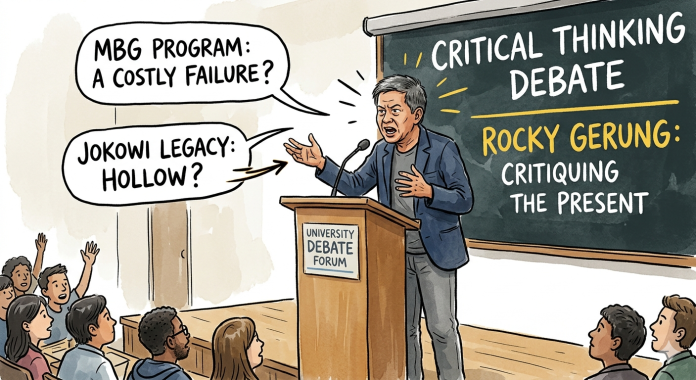

RADAR TULUNGAGUNG – A heated public discussion featuring Rocky Gerung turned into a fiery critique of the MBG program, political literacy, freedom of criticism, and the future of nonformal education in Indonesia. Speaking before students and academics at a university forum, Rocky delivered sharp remarks about the government, public opinion, and the state of democracy.
The discussion quickly gained attention after Rocky openly declared the MBG program had failed. The keyword “MBG program” repeatedly emerged throughout the debate as students questioned the academic foundation behind the policy and its long-term direction under President Prabowo Subianto.
One participant directly challenged Rocky about how close Prabowo was to the academic draft of the MBG program. The student argued that the public had never fully seen the academic manuscript behind the policy and questioned whether the program had undergone serious evaluation.
Rocky responded bluntly. He stated that the MBG program had already been discussed extensively and concluded with a controversial statement that the policy was essentially a failure. His answer triggered applause from the audience, but Rocky also warned students not to stop at intellectual excitement alone.
Rocky Gerung Urges Students to Stay Critical
During the forum, Rocky repeatedly emphasized the importance of critical thinking among university students. He argued that campuses should remain spaces for argumentation and intellectual resistance instead of becoming extensions of political power.
According to him, many students today are trapped between fear and cynicism due to growing pressure against dissenting opinions. He cited several examples of critics and public figures who faced intimidation after expressing controversial views.
Rocky also touched on the debate surrounding former President Joko Widodo and criticism aimed at public officials. He argued that criticism and praise are both forms of description, questioning why harsh criticism is often criminalized while excessive praise receives no legal scrutiny.
He further explained that academic criticism should focus on analyzing policies rather than merely creating sensational statements. Rocky stressed that criticism does not always require immediate solutions because the role of universities is to problematize public issues, while governments are responsible for solving them.
“The duty of campuses is to question power,” he told the audience during the discussion.
MBG Program and Public Relations Politics
The MBG program again became a central topic when Rocky criticized what he called the dominance of public relations over genuine public opinion. He claimed modern political communication often focuses more on image-building than intellectual transparency.
Rocky compared the term “Prabowonomics” with established economic doctrines such as Reaganomics. According to him, academic concepts usually emerge from universities and intellectual discourse, while political branding created directly by politicians functions more as public relations strategy.
He challenged universities to critically examine the ideological foundation behind government economic programs, including the MBG program, instead of simply accepting political narratives.
The discussion also expanded into broader political issues, including the Omnibus Law, IKN development, and state policies linked to large-scale projects.
Papua Discussion Draws Strong Reaction
One of the most emotional moments occurred when a student from Papua asked about education access and conflict in the region. Rocky responded by describing Papua as a long-standing unresolved issue within Indonesia.
He argued that Papua faces not only political tension but also global geopolitical interests due to its natural resources. Rocky warned that Papua’s ecological wealth and indigenous communities risk exploitation through industrial projects such as food estate development.
According to him, many government projects in Papua are designed without fully considering indigenous culture and environmental sustainability. Rocky even questioned whether large-scale projects genuinely benefit Papuan communities.
His remarks about uranium reserves, global security interests, and future geopolitical competition drew loud reactions from the audience.
Nonformal Education Becomes Major Theme
Beyond politics, the discussion strongly focused on nonformal education. Several lecturers and students argued that Indonesia’s education system remains too elitist and disconnected from ordinary citizens.
Rocky supported the idea that nonformal education could become a powerful tool for public emancipation. He cited historical examples from Britain and Indonesia to explain how alternative education movements often emerge when formal institutions fail to reach marginalized communities.
The political philosopher concluded the session by encouraging students to continue building intellectual courage. He reminded the audience that universities should produce critical citizens instead of passive followers of authority.
The discussion ended with applause after Rocky delivered a final statement saying philosophy often “misleads people onto the right path,” a remark that immediately sparked laughter and cheers from participants.