
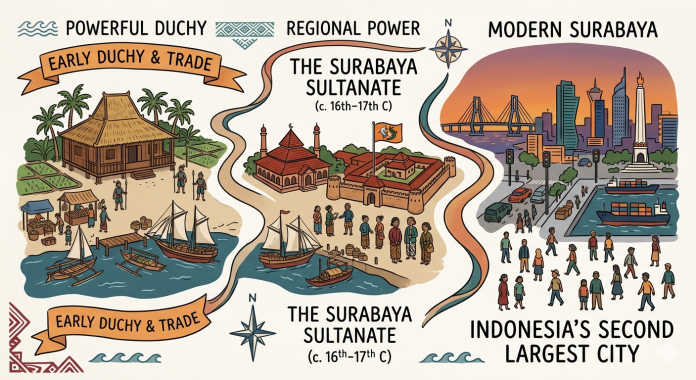

RADAR TULUNGAGUNG – Long before becoming the bustling metropolitan city known today, Surabaya once stood as one of the most influential duchies in eastern Java. Historical records reveal that the Duchy of Surabaya controlled not only the present-day city area but also parts of Sidoarjo, Gresik, and Bawean Island. The region emerged as an international trading port, turning Surabaya into a cosmopolitan center with strong political and economic influence in East Java.
The history of the Surabaya Duchy remains one of the most fascinating chapters in Javanese civilization. Before colonial powers arrived, Surabaya had already developed into a major Islamic cultural hub. Historians believe the city existed centuries before its officially recognized founding date on May 31, 1293. During the era of the Singasari Kingdom, Majapahit Empire, and later the Demak Sultanate, Surabaya continued to strengthen its role as a strategic coastal power.
After breaking away from Demak, the Duchy of Surabaya rose as the dominant force in eastern Java during the late 16th century. The palace became a center of Islamic Javanese literature and culture, rivaling inland kingdoms such as Pajang and Mataram. In the early 17th century, Surabaya formed alliances with Pasuruan and expanded its influence across East Java, directly challenging the power of the Mataram Sultanate.
The Rise of Legendary Surabaya Rulers
Several legendary leaders shaped the glory of Surabaya during this period. Names such as Adipati Joyolengkoro, Pangeran Pekik, Adipati Jayengrono, and Aryo Joyopuspito became symbols of Surabaya’s political strength. Historical accounts also suggest that early Surabaya rulers were descendants of Sunan Ampel, one of the most respected Islamic missionaries in Java during the late Majapahit era.
However, Surabaya’s independence eventually ended after Sultan Agung of Mataram conquered the region in 1625. The city later fell under the control of the Dutch East India Company or VOC in 1743 following the turmoil of the Chinese Rebellion known as Geger Pecinan.
Under colonial administration, Surabaya’s political status declined into a regency. Yet, the city remained unique because it was once governed simultaneously by two regents from different aristocratic families: the Kasepuhan and Kanoman dynasties. Both families claimed descent from the same ancestral lineage connected to Islamic nobility in East Java.
The Twin Regency System of Surabaya
According to historical manuscripts, Surabaya officially adopted the dual-regent system in 1752. Raden Tumenggung Jimat Tjondronegoro ruled the Kasepuhan branch, while Raden Tumenggung Joyodiningrat governed the Kanoman side. This unusual arrangement reflected internal competition among noble descendants seeking control over Surabaya.
Evidence of these two ruling families can still be traced through royal cemeteries, ancient mosques, and historical neighborhoods scattered around Surabaya. Areas such as Kebon Rojo, Bubutan, Kepanjen, and Baliwerti preserve memories of the former royal administrative complex once known as the Keraton Surabaya.
Dutch missionary and naturalist Francois Valentijn, who visited Surabaya in the early 1700s, described the regent’s palace as magnificent and luxurious. He noted wide streets, a vast town square, and elegant pendopo halls decorated with gamelan instruments and royal ornaments. Valentijn even recorded that the Surabaya regent frequently traveled across the city riding elephants, highlighting the grandeur of local aristocracy.
Colonial Changes and the Birth of Modern Surabaya
The Dutch colonial government eventually considered the dual-regent system inefficient. In 1863, the authorities appointed Raden Adipati Aryo Tjokronegoro IV as the sole regent of Surabaya, officially ending the Kasepuhan and Kanoman division.
During the late 19th and early 20th centuries, Surabaya transformed rapidly into a modern colonial city. The regent’s palace in Kebon Rojo was later converted into administrative buildings before being demolished in 1928. The land eventually became the site of the famous Surabaya Central Post Office and nearby public spaces that later evolved into the Tugu Pahlawan complex.
Another major turning point came in 1935 when the Dutch government temporarily moved the capital of Surabaya Regency to Gresik. However, the experiment lasted only two years before the administrative center returned to Surabaya. A new regent residence was then established in Genteng Kali, an area once associated with the Kanoman dynasty.
The End of Surabaya Regency
Following Indonesian independence, administrative changes continued reshaping the region. In 1974, the Indonesian government officially renamed Surabaya Regency as Gresik Regency through Government Regulation Number 38 of 1974. Since then, the historical identity of Surabaya Regency gradually disappeared, leaving only the modern City of Surabaya as the surviving symbol of its glorious past.
Today, remnants of Surabaya’s aristocratic history still survive in cultural landmarks, old mosques, traditional neighborhoods, and the former regent complex now known as the East Java Cultural Park. The long journey from powerful duchy to modern metropolis reflects Surabaya’s enduring importance in the history of East Java and Indonesia.