
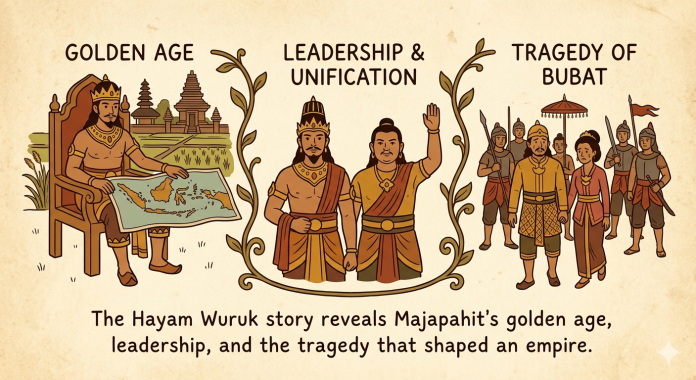

RADAR TULUNGAGUNG – Hayam Wuruk story remains one of the most compelling narratives in Indonesian history, blending power, wisdom, and tragedy into a legacy that defined the golden age of the Majapahit Empire.
Born during a dramatic natural event marked by the eruption of Mount Kelud, Hayam Wuruk’s arrival was seen as a divine sign. The young prince, son of Queen Tribhuwana Tunggadewi and Sri Kertawardhana, grew up in the royal court of Trowulan, where he was groomed to become a wise and balanced leader.
From an early age, the Hayam Wuruk story reflects a unique blend of intellect and compassion. He was not only trained in warfare and governance but also in philosophy, culture, and religious harmony. His mother instilled in him the values of leadership rooted in wisdom rather than domination.
Early Leadership and Coronation
At just 17 years old, Hayam Wuruk ascended the throne of Majapahit. His coronation marked a new chapter for the kingdom, though not without skepticism from some nobles who doubted his youth.
However, the Hayam Wuruk story quickly proved his critics wrong. Guided by the legendary Prime Minister Gajah Mada, he established a governance style that balanced strength with diplomacy. While Gajah Mada pursued territorial expansion through his famous Sumpah Palapa, Hayam Wuruk emphasized unity built on trust rather than fear.
This dual leadership propelled Majapahit into its peak. Trade flourished across Southeast Asia, infrastructure improved, and cultural life thrived. Ports became bustling centers of commerce, connecting Java to regions such as Malacca and beyond.
Golden Age of Majapahit
Under his rule, Majapahit reached unprecedented prosperity. The Hayam Wuruk story during this period highlights economic growth, political stability, and cultural achievements.
He encouraged the development of arts and literature, leading to the creation of important works like Negarakertagama. The famous motto Bhinneka Tunggal Ika, unity in diversity, emerged during this era, symbolizing his vision of a harmonious society.
Unlike many rulers of his time, Hayam Wuruk frequently visited villages, spoke directly with farmers, and listened to the concerns of traders. This approach strengthened trust between the palace and the people.
The Tragedy of Bubat
Despite his achievements, the Hayam Wuruk story is also marked by deep tragedy. His plan to marry Princess Dyah Pitaloka of Sunda was intended to forge a peaceful alliance between two great kingdoms.
However, a fatal misunderstanding occurred. Gajah Mada interpreted the marriage as a symbol of Sunda’s submission to Majapahit. This led to the infamous Bubat tragedy, where the Sunda royal entourage was attacked.
The battle ended in devastation, and Princess Dyah Pitaloka chose to end her life to preserve her honor. When Hayam Wuruk arrived, he was confronted not with a wedding celebration, but with loss and regret.
This event left a lasting scar on him. Although he continued to rule wisely, the tragedy changed his perspective on power and conquest.
Final Years and Legacy
In his later years, the Hayam Wuruk story becomes more reflective. He shifted focus toward cultural unity, religious tolerance, and governance reform. Temples of both Hindu and Buddhist traditions were built side by side, reinforcing harmony across beliefs.
Following the death of Gajah Mada, internal conflicts began to emerge within the kingdom. Hayam Wuruk worked tirelessly to maintain stability, but the absence of his trusted advisor created new challenges.
Despite these difficulties, he remained committed to peaceful leadership. He strengthened diplomacy with foreign kingdoms and ensured that Majapahit continued to prosper.
When Hayam Wuruk passed away, he left behind more than just a vast empire. His legacy was a vision of leadership grounded in compassion, wisdom, and unity.
The Hayam Wuruk story teaches that true greatness is not measured by conquest alone, but by the ability to create harmony among diverse people. His reign stands as a timeless reminder that power must be guided by humanity.