

RADAR TULUNGAGUNG – Majapahit Kingdom history stands as one of the most remarkable stories in Southeast Asian civilization. Known as Indonesia’s greatest empire, Majapahit once controlled vast territories across the archipelago and played a key role in shaping regional power and culture.
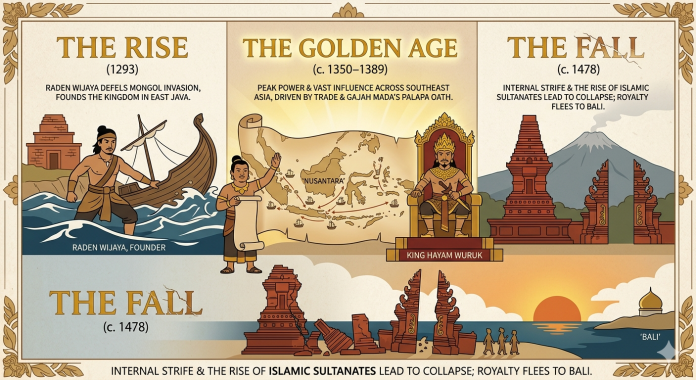
Founded in 1293 by Raden Wijaya, the Majapahit Kingdom history began in East Java, centered in what is now Trowulan. The kingdom rose from the fall of the Singasari Kingdom, emerging during a time of political instability and foreign intervention.
What makes the Majapahit Kingdom history especially compelling is how it transformed from a small kingdom into a dominant regional empire. Through strategic leadership, military strength, and control of trade routes, Majapahit became a symbol of unity across the archipelago.
The Strategic Rise of Majapahit
Raden Wijaya played a crucial role in establishing the kingdom. After escaping the destruction of Singasari, he sought protection in Madura and gained support from Arya Wiraraja. When Mongol forces arrived in Java to punish the former Singasari ruler, Wijaya used the situation to his advantage.
He formed a temporary alliance with the Mongols to defeat Jayakatwang, the ruler of Kediri who had overthrown Singasari. However, after securing victory, Wijaya turned against the Mongol troops and forced them to withdraw from Java. This bold strategy secured his position, and he was crowned as Kertarajasa Jayawardhana, marking the official founding of Majapahit.
Expansion and Golden Age Under Hayam Wuruk
The Majapahit Kingdom history reached its peak during the reign of Hayam Wuruk from 1350 to 1389. Supported by his powerful prime minister, Gajah Mada, the empire expanded its influence across Southeast Asia. Territories such as Sumatra, the Malay Peninsula, Borneo, Sulawesi, and parts of the Philippines were connected under Majapahit’s sphere.
Gajah Mada’s famous Palapa Oath reflected his ambition to unite the archipelago under one rule. This period is widely regarded as the golden age of Majapahit, marked by political stability, economic growth, and cultural development.
Political Power and Maritime Strength
Majapahit was both an agricultural and maritime power. Its economy relied on rice farming supported by irrigation systems, as well as extensive trade networks across the region. The kingdom controlled important commodities such as spices, textiles, and metals.
Although Majapahit claimed vast territories, historians believe that many regions were not directly governed. Instead, they were connected through trade relationships, tribute systems, and political alliances.
The Bubat Tragedy and Internal Conflict
One of the most controversial events in Majapahit Kingdom history is the Bubat incident in 1357. Originally intended as a royal marriage alliance between Majapahit and the Sunda Kingdom, the event turned into a violent conflict.
A misunderstanding over political status led to a battle in which the Sunda royal family was defeated. This tragedy left a lasting impact on Majapahit’s reputation and remains a significant historical debate.
Cultural and Religious Harmony
Majapahit is also known for its cultural achievements. Literary works such as the Nagarakretagama and Sutasoma flourished during this period. The famous phrase “Bhinneka Tunggal Ika,” meaning “Unity in Diversity,” originated from this era.
The kingdom promoted religious tolerance, particularly between Hinduism and Buddhism. This harmony influenced social life and governance, making Majapahit a culturally advanced society.
The Decline of Majapahit
After the death of Hayam Wuruk in 1389, Majapahit began to weaken. Internal conflicts, including the Paregreg civil war, reduced the kingdom’s stability. At the same time, the rise of Islamic trading states in the region shifted the balance of power.
The emergence of the Demak Sultanate in Java further accelerated Majapahit’s decline. By 1527, Majapahit had lost its dominance, marking the end of its long-standing influence in the region.
Legacy of a Great Empire
Despite its fall, the legacy of Majapahit continues to live on. Many nobles and cultural figures moved to Bali, preserving traditions and values from the kingdom. Today, Majapahit is remembered as a symbol of unity, power, and cultural richness in Indonesian history.
The Majapahit Kingdom history is not just a story of conquest and power, but also one of strategy, diplomacy, and cultural integration that shaped the identity of a nation.