
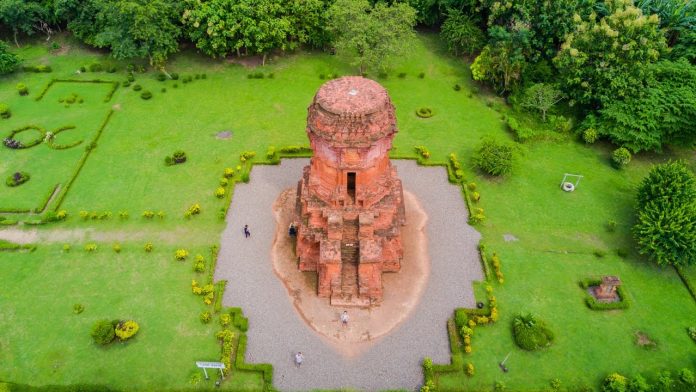

RADAR TULUNGAGUNG – The mystery surrounding Jabung Temple continues to captivate historians and travelers alike. Located in East Java, this Majapahit-era structure stands out not only for its towering red-brick architecture but also for its unusual cylindrical shape, which many say resembles a rocket ready for launch. The story of Jabung Temple is deeply tied to the glory of the Majapahit Kingdom and its influential rulers, making it a key historical site worth exploring.
Jabung Temple was built during the golden age of the Majapahit Kingdom, a period strongly associated with the reign of Hayam Wuruk. Historical records such as the Negarakertagama mention the king’s visit to this sacred site in 1359. Interestingly, the region of Keta, once conquered under the leadership of Tribhuwana Wijayatunggadewi and her prime minister Gajah Mada, later welcomed Hayam Wuruk warmly, reflecting the prosperity brought by Majapahit rule.
A Temple Built to Honor Royal Legacy
Jabung Temple was originally constructed as a tribute to a noblewoman known as Bhra Gundal, a relative of Hayam Wuruk. According to ancient texts like the Pararaton, the temple was named Bajrajinaparimitapura. Today, it stands as a symbol of remembrance and spiritual devotion, showcasing how the Majapahit civilization honored its elites.
The temple’s structure is divided into three main parts: the base (batur), the foot, and the body. Its red-brick construction, restored between 1983 and 1987, highlights the advanced architectural techniques of the era. Despite weathering over centuries, intricate carvings of tendrils, medallions, and symbolic motifs remain visible, reflecting themes of prosperity and protection.
The Only Cylindrical Temple in Java
One of the most striking features of Jabung Temple is its cylindrical body, a rare design in Javanese temple architecture. Unlike the typical box-shaped temples, this structure resembles a stupa, leading some scholars to associate it with Buddhist influences. However, elements such as Garuda and chakra carvings, symbols of the Hindu god Vishnu, suggest a fusion of religious beliefs.
This blend of Hindu and Buddhist elements was common during the Majapahit era, influenced by Tantric traditions. Similar syncretism can be seen in other temples like Jawi Temple, where both religious styles coexist harmoniously.
Lion Reliefs and Symbolic Guardians
Another fascinating aspect of Jabung Temple is the abundance of lion reliefs carved into its base. These lions symbolize strength, courage, and protection in both Hindu and Buddhist traditions. While lions are not native to Java, their imagery was introduced through Indian cultural influence.
In addition to lion carvings, the temple is guarded by kirtimukha, fierce mythical faces placed above entrances to ward off evil. Combined with other protective symbols like tapak dara, these elements create multiple layers of spiritual defense around the temple.
Myth or Reality The Astral Portal Theory
Jabung Temple is also surrounded by mystical stories. One popular belief suggests that the temple acts as a portal to the astral world. This theory is linked to the relief of Sri Tanjung, a legendary figure whose spirit was said to travel to the afterlife on a fish. Such narratives reinforce the temple’s role as a sacred space dedicated to the deceased.
Although there is no scientific evidence supporting these claims, the presence of such reliefs indicates that the temple was indeed associated with spiritual transitions and ancestral worship.
A Timeless Symbol of Majapahit Glory
Situated near the northern coast of East Java, Jabung Temple once served as a significant spiritual destination during the Majapahit era. Its proximity to trade routes may have contributed to its grandeur and cultural richness.
Today, Jabung Temple remains a powerful reminder of Indonesia’s rich historical heritage. Despite the passage of time, its charm and mystery continue to attract visitors and researchers. More than just an ancient structure, it stands as a testament to the sophistication, spirituality, and resilience of the Majapahit civilization.