
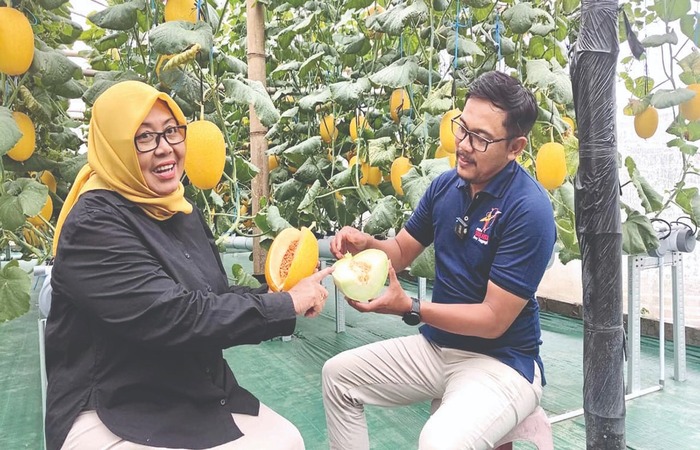

RADAR TULUNGAGUNG – The melon greenhouse in Tunggangri has completed its first hydroponic harvest. As a result, village leaders now target up to 50% net profit from premium melon sales and agro-tourism.
Rows of yellow and green melons hang neatly inside the greenhouse in Ngrawan hamlet, Kalidawir district, Tulungagung. The fruit reached harvest maturity after about 70 days. Meanwhile, the village-owned enterprise BUMDes Srikandi manages the project with local government support.
Farmers rely on two premium varieties, Sweet Lavender and Honey Blue. Both offer strong sweetness and market value. According to village head Sri Lailatin, the first harvest met expectations in quality and demand.
“This initial planting produced very satisfying results. Therefore, it is a strong start for future expansion,” she said.
The greenhouse hydroponic system allows tighter quality control. Moreover, it reduces weather risks. As a result, the melons show cleaner skin, uniform size, and stable sweetness. In addition, the method supports consistent supply during peak periods such as Ramadan.
Beyond direct sales, BUMDes Srikandi plans to open a melon-picking tourism program by late February. Visitors will select and harvest fruit directly from the vines. Consequently, the site will function as an agro-tourism attraction.
The melons sell for 25,000 to 27,000 rupiah per kilogram. Even before the official opening, orders arrived through village networks and partners. Therefore, managers set prices after detailed cost calculations to maintain healthy margins.
“We target at least 50% net profit. Overall, this proves the program is a serious and sustainable village business,” Sri said.
The Ngrawan greenhouse marks only the first phase. Meanwhile, the village has prepared additional land south of the site for expansion. Leaders view the project as a step toward technology-based modern farming at the village level.
“We want village agriculture to move up a level and deliver real economic benefits,” she added.