

RADAR TRENGGGALEK – The Trenggalek teacher assault verdict has drawn strong support from Indonesia’s largest teachers’ association, which says the ruling marks more than the end of a legal battle.
The East Java chapter of the Indonesian Teachers Association (PGRI) described the decision by the Trenggalek District Court as a crucial moment to defend the dignity of the teaching profession.
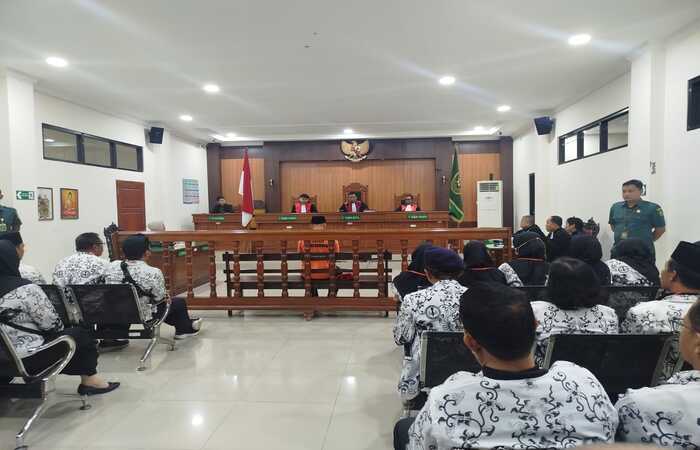
The case centered on the assault of Eko Prayitno, a teacher at SMPN 1 Trenggalek. Judges at the district court recently delivered their verdict, concluding the first stage of legal proceedings.
However, for PGRI East Java, the ruling carries broader meaning. The organization views it as a wake-up call to strengthen respect and protection for educators nationwide.
Nur Basuki, a representative of PGRI East Java’s Legal Bureau, thanked various groups that supported the legal process from start to finish.
“We appreciate everyone who stood with PGRI in resolving Mr. Eko Prayitno’s case,” Nur Basuki said on Tuesday (February 10).
Support came not only from teachers but also from youth organizations such as GMNI and PMII. In addition, members of the public actively monitored the proceedings.
According to Nur Basuki, this cross-sector solidarity proved essential. It demonstrated that concern over violence against teachers extends far beyond the education community.
Moreover, public attention ensured transparency throughout the trial. As a result, the court proceedings unfolded under close scrutiny.
Despite its support for the verdict, PGRI East Java stressed that it did not seek imprisonment as its primary goal.
“In principle, we do not wish to see anyone jailed,” Nur Basuki emphasized. “However, we carry a responsibility to protect the dignity and honor of teachers.”
For that reason, the organization deployed its legal bureau to assist the victim’s legal team. PGRI framed this step as institutional responsibility rather than retaliation.
The association argues that safeguarding teachers’ authority in classrooms remains vital. Without such protection, educators may struggle to perform their duties effectively.
PGRI East Java also acknowledged the role of local residents and journalists in Trenggalek. The organization praised reporters for delivering balanced and objective coverage.
According to Nur Basuki, responsible journalism helped the public understand the full context of the case. Consequently, misinformation did not dominate the narrative.
He expressed hope that this synergy between civil society and the press could serve as a model for other regions handling similar cases involving teachers.
As the first-instance trial concludes, PGRI East Java is urging parents and communities to reflect on the broader implications.
Teachers, the organization stressed, act as second parents within school environments. Therefore, society must treat them with respect and protection.
“It is deeply ironic when educators who guide the nation’s future become victims of violence,” Nur Basuki said.
He added that honoring teachers ultimately means safeguarding the future of Indonesia’s education system.
Looking ahead, PGRI hopes the Trenggalek teacher assault verdict will foster collective awareness. By reinforcing legal accountability and public solidarity, the organization believes similar incidents can be prevented.
Ultimately, the case has evolved beyond a courtroom decision. Instead, it has become a defining moment in Indonesia’s ongoing effort to uphold the dignity and safety of its educators.