Tag: food security

  • Young Farmers in Tulungagung Remain Below 10 Percent as Regeneration Challenge Grows

    TULUNGAGUNG – Young farmers in Tulungagung still account for less than 10 percent of the region’s agricultural workforce, raising concern over the long-term future of local farming.

    Agricultural officials say the low number has become a serious challenge because most active farmers now belong to older age groups.

    Anang Ismindanto, head of the district agricultural extension working team, said weak interest among younger generations continues to slow farmer regeneration.

    He noted that agriculture still plays an important role in supporting household income across many parts of Tulungagung.

    To address the issue, the government introduced the Youth Entrepreneurship and Employment Support Services program, widely known as YESS, from 2021 to 2025.

    The program targets young people by offering practical skills, agricultural knowledge, and business guidance.

    “Through the YESS program, young people receive training and business assistance. The goal is to make them interested in developing agricultural businesses,” Anang said.

    Over five years, the program reached 10,927 beneficiaries in Tulungagung.

    Participants joined basic training, advanced courses, and direct mentoring for agricultural business development.

    They also had the chance to compete for grant funding to support business plans they had prepared.

    Officials designed that scheme to encourage participants to start independent agricultural ventures.

    Anang said the program expects alumni to go beyond building personal businesses.

    They also encourage other young people to enter agriculture by sharing experience and showing practical results.

    “We encourage our alumni to become drivers of change and show that agriculture also offers business opportunities,” he said.

    Despite that effort, Anang admitted that farmer regeneration remains difficult.

    Older farmers still dominate the sector across most rural areas.

    Limited access to land also discourages younger people from entering agriculture.

    Many young residents still believe farming offers uncertain income and slower financial returns.

    Because of that perception, many choose non-agricultural jobs that provide quicker and more predictable earnings.

    That trend has made regeneration move more slowly than actual field needs require.

    Agricultural officials hope future programs will continue supporting young farmer development.

    They believe sustained policy support is necessary to keep local agriculture productive and secure future food supply.

    “We hope programs like this will continue,” Anang said.
  • Tulungagung Rice Reserves Secure Through 2026 as Regional Food Stock Exceeds Target

    TULUNGAGUNG – Tulungagung authorities say regional rice reserves remain secure through the end of 2026, with current food stocks already exceeding most annual emergency needs.

    The local government has prepared regional food reserves to anticipate price instability, natural disasters, and urgent social assistance needs. Officials said the reserve currently holds 60.27 tons of rice.

    Dinas Ketahanan Pangan Tulungagung distribution and food reserve official Hari Pujianto said the stock will increase again during the main harvest season.

    “Our current stock stands at 60.27 tons. We plan another procurement of around 19 tons in April or May during the main harvest,” he said.

    That addition would raise total rice reserves to about 79 tons. Officials believe the figure will fully cover emergency needs across the district next year.

    Hari said the amount already exceeds the annual target set by the regional government, which stands at 70 tons. The reserve functions as buffer stock and is not intended for regular daily distribution.

    He explained that authorities only use the rice during emergencies. These include floods, landslides, food insecurity, and support for people living in extreme poverty.

    “This reserve is specifically prepared for emergency situations such as floods, landslides, or extreme poverty response,” he said.

    The district no longer stores rice directly in government warehouses. Officials changed the system to avoid quality loss, shrinkage, and pest damage.

    Since 2017, the government has worked with local rice mills to manage reserve supplies. Under this system, partners maintain stock and deliver fresh rice when authorities request it.

    “In the past, direct storage often caused losses because of pests or reduced quality. Now we cooperate with local rice mills,” Hari said.

    The agreement requires rice mills to provide fresh rice quickly whenever the district needs emergency supply. Officials say this method also makes food reserve management more flexible.

    With sufficient stock and faster distribution, Tulungagung expects to meet emergency food demand without relying on supply from outside the region.

  • TNI-Community Rice Planting in Blitar Village Boosts Food Security Under TMMD Program

    TNI-Community Rice Planting in Blitar Village Boosts Food Security Under TMMD Program

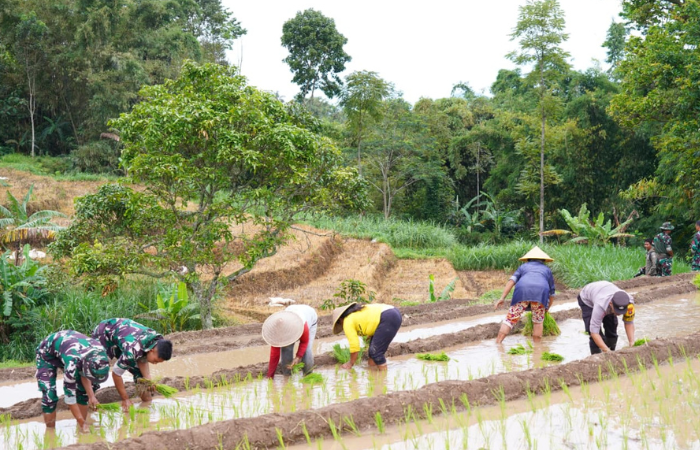
    RADAR BLITAR – A joint rice planting initiative between Indonesian soldiers and villagers is underway in Blitar, East Java. The effort forms part of a national food security drive under the military’s rural development program, TMMD. As a result, troops and farmers are working side by side to cultivate community farmland.

    The activity took place in Krisik Village. There, personnel from the TMMD task force planted rice seedlings together with local farmers. In addition, village officials and community police officers joined the effort.

    The program is part of TMMD’s non-physical targets, which focus on empowerment as well as infrastructure. Soldiers first helped prepare the land. They then planted seedlings using proper spacing patterns so yields can improve.

    “The TMMD task force coordinated with landowners and directly joined farmers in planting rice,” said Lt. Col. Inf. Virlani Arudyawan, commander of the TMMD task force from Kodim 0808/Blitar.

    The rice planting drive supports Indonesia’s national food security program, a priority of the Army Chief of Staff. Moreover, the initiative promotes the use of idle or underproductive land. Consequently, it aims to strengthen rural food production capacity.

    According to Arudyawan, TMMD activities are designed to bring soldiers closer to rural communities. Therefore, military personnel can better understand village life and local challenges. “Soldiers must truly integrate with village life,” he said.

    Residents welcomed the soldiers’ presence in the fields. Farmers and troops worked together from land preparation to transplantation. As a result, the cooperative spirit of TMMD was clearly visible.

    “Through this activity, we want to encourage mutual cooperation and help increase agricultural productivity. Food security begins in villages,” Arudyawan said. Furthermore, he expressed hope that harvests would increase and improve farmers’ livelihoods.

    TMMD or TNI Manunggal Membangun Desa, is a nationwide initiative to accelerate rural development. It also seeks to improve living standards through infrastructure and empowerment programs. The current 127th cycle combines both approaches.

    In Krisik Village, the rice planting campaign shows how military–community collaboration can strengthen local food resilience. At the same time, it reinforces ties between the armed forces and rural society.

  • Ahead of Ramadan and Eid, Blitar Ensures Stable Food Supply and Urges Calm Buying

    Ahead of Ramadan and Eid, Blitar Ensures Stable Food Supply and Urges Calm Buying

    RADAR BLITAR – Food supply in Blitar remains stable ahead of Ramadan and Eid al-Fitr 1447 Hijri, local authorities said, urging residents not to panic buy. The district food security agency reported sufficient stocks of key staples across markets and reserves.

    Fauzia Laame, head of food security at the Blitar Agriculture and Food Security Agency, said monitoring and cross-sector coordination show steady supplies. She said stocks will remain secure from early Ramadan through Eid. Markets and government reserves still hold ample quantities.

    Upcoming rice harvests in March and April will reinforce supply. Many fields across Blitar have entered the growing stage and will reach harvest soon. This outlook supports food availability through the festive period.

    Officials noted possible price fluctuations in chili due to farm-level production issues. However, rice, cooking oil, sugar, and meat remain well supplied. The agency continues to track distribution to prevent retail shortages.

    The Blitar government has expanded mitigation steps to keep prices affordable. It strengthened the Gerakan Pangan Murah program, which sells staples below market price at public distribution points. The program targets vulnerable households and busy urban areas.

    Fauzia urged residents to shop responsibly and avoid hoarding. Balanced consumption helps maintain stable supply and prices. Authorities will keep overseeing stocks to ensure smooth Ramadan fasting and Eid celebrations.

Tim dukungan pelanggan kami siap menjawab pertanyaan Anda. Tanyakan apa saja!