
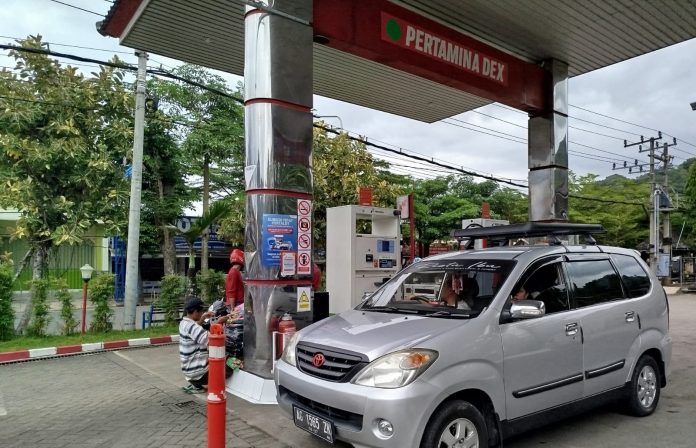

TRENGGALEK – The subsidized fuel supply in Trenggalek remains secure despite concerns over rising non-subsidized fuel prices. Local officials say allocations for both Pertalite gasoline and Bio Solar diesel remain sufficient and should meet public demand through the end of 2026.
Data from the Trenggalek administration show that fuel consumption has stayed well below the annual quota set by the central government. As of the end of May, usage of both fuel types had not reached half of the total allocation.
Agus Subchi, Acting Head of the Economic and Natural Resources Division at the Trenggalek Regional Secretariat, said the Ministry of Energy and Mineral Resources (ESDM) determined the region’s fuel quota through an official allocation issued in March 2026.
“For 2026, Trenggalek received a quota of 23,793 kiloliters of Bio Solar and 38,116 kiloliters of Pertalite,” Agus said.
According to the latest figures, Bio Solar consumption reached around 7,250 kiloliters by May 31. The figure remains far below 50 percent of the annual allocation.
“As of May 31, diesel distribution stood at around 7,250 kiloliters. The realization remains below half of the quota, so supplies should remain safe until the end of the year,” he explained.
Pertalite consumption also remained under control during the first five months of the year. Distribution reached approximately 12,501 kiloliters from the total allocation of 38,116 kiloliters.
“Pertalite realization stands at around 12,501 kiloliters. That equals roughly 30 percent of the annual quota, so the supply remains relatively secure,” Agus added.
Officials acknowledge that higher prices for non-subsidized fuels could encourage more motorists to switch to subsidized products. Even so, the Trenggalek administration remains confident that current allocations can accommodate potential increases in demand.
To prevent shortages, the local government continues to monitor fuel distribution and consumption on a regular basis. Officials review usage data and assess supply conditions throughout the region.
The administration also maintains close coordination with the East Java Energy and Mineral Resources Agency and state-owned energy company Pertamina. Authorities consider the cooperation essential for maintaining stable fuel distribution.
“We continue to communicate with the provincial ESDM office and Pertamina to ensure distribution remains smooth,” Agus said.
He added that regular monitoring and coordination play a crucial role in maintaining supply stability, especially as national energy prices continue to fluctuate.
With fuel absorption rates still below 50 percent, the Trenggalek administration believes subsidized fuel supplies remain under control. Officials expect Bio Solar and Pertalite stocks to remain available for residents through the remainder of 2026.
“As long as monitoring and coordination continue, we remain optimistic that the public’s subsidized fuel needs will be met,” Agus said.