
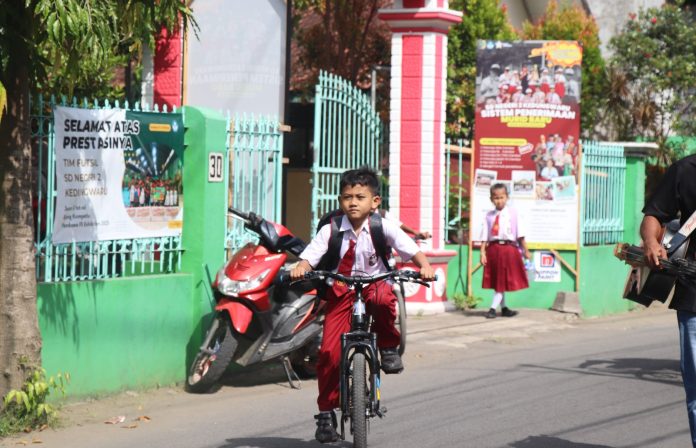

TULUNGAGUNG – Student enrollment remains a major concern for education officials in Tulungagung ahead of the 2026/2027 academic year. Several public elementary schools continue to face the risk of attracting very few new students despite efforts to improve enrollment distribution across the region.
The issue emerged again as the Tulungagung Education Office prepared for the upcoming Student Admission System, known locally as SPMB. Officials are reviewing lessons from previous admission periods, when some schools recorded extremely low enrollment numbers.
In one case, a public elementary school admitted only two new students during the last enrollment cycle. The situation highlighted ongoing disparities between schools and raised questions about the long-term sustainability of institutions with declining student populations.
Deni Susanti, secretary of the Tulungagung Education Office, said authorities have developed several strategies to reduce the gap in student enrollment among schools.
“We map student admissions according to designated enrollment areas. We also determine each school’s quota based on an analysis of graduates within that area,” Deni said.
Education officials believe the approach can help distribute students more evenly. For years, some schools have received far more applicants than available seats. At the same time, other schools have struggled to attract enough students to fill classrooms.
The new admission plan aims to create a more balanced enrollment pattern across public elementary schools. Authorities hope the policy will prevent sharp differences in student numbers between neighboring institutions.
Despite these preparations, the Education Office has not yet decided how it will respond if schools continue to receive very small numbers of students during the upcoming admissions process.
Officials plan to conduct a detailed evaluation before making any policy decisions. One option under consideration involves restructuring the school network, including the possibility of merging schools if enrollment levels remain unsustainably low.
“We will analyze the data first before determining the next steps,” Deni said.
The evaluation will examine several factors. Officials will review student numbers, school locations, and teacher-to-student ratios. They will also assess the distance between nearby schools.
According to Deni, schools located within one to three kilometers of each other could become part of future discussions about restructuring. However, authorities have not announced any specific merger plans.
Data from the Education Office show that several public elementary schools have experienced declining student enrollment in recent years. Multiple factors contribute to the trend. Lower birth rates have reduced the number of school-age children. At the same time, many parents prefer to enroll their children in schools that enjoy stronger reputations.
As a result, some schools attract large numbers of applicants while others struggle to maintain enrollment levels.
The outcome of the 2026/2027 Student Admission System will play an important role in future education planning. Local authorities intend to use the results as a basis for evaluating elementary school management across Tulungagung.
If officials identify schools with critically low enrollment, they will conduct further studies before implementing any structural changes. The Education Office says any decision will consider educational quality, accessibility, and long-term sustainability for students and teachers alike.