RADAR BLITAR – The Ngaglik railway crossing closure has officially taken effect after a fatal train accident claimed a motorcyclist’s life in Blitar, East Java.
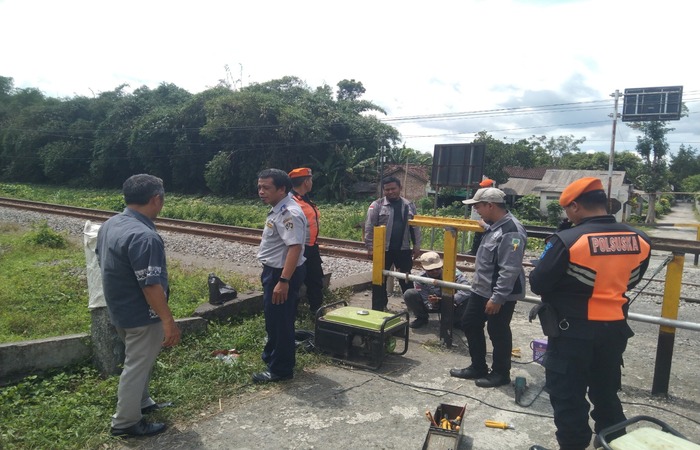
The Blitar Transportation Agency and the Traffic Unit of Blitar City Police permanently shut down the unmanned railway crossing in Sendung Hamlet, Ngaglik Village, Srengat district, on February 12. Officials barred all vehicles from accessing the crossing without exception.
Authorities moved quickly after a motorcycle collided with the Singasari train at the same location a day earlier. The crash killed the rider instantly and reignited concerns over safety at the unguarded crossing.
To enforce the closure, officers installed iron barriers across the railway access, physically preventing both motorcycles and cars from passing through.
Puguh Imam Santoso, head of the Blitar Transportation Agency, said the decision followed a formal meeting of the Regional Traffic and Road Transportation Forum (LLAJ).
“We closed the unmanned level crossing based on the LLAJ forum’s decision, especially after the fatal accident occurred at the site,” Puguh said.
He stressed that the crossing posed a serious danger to residents. Over the past year alone, three train-related accidents occurred at the same spot, resulting in multiple fatalities.
“Last year, three accidents at this crossing also claimed lives,” he added.
Previously, authorities attempted to shut down the crossing entirely. However, protests from nearby residents forced officials to compromise. At that time, they restricted access only to four-wheeled vehicles while still allowing motorcycles to pass.
Nevertheless, after the latest deadly collision, officials reassessed the risk and decided to implement a full closure for all types of vehicles.
“Following yesterday’s accident, we decided to close the crossing completely for every vehicle,” Puguh confirmed.
According to local transportation regulations, the crossing should not have functioned as a vehicle route in the first place. The distance between that crossing and the nearest one measures only 600 meters.
Regulations require a minimum distance of 800 meters between railway crossings. Therefore, the Ngaglik crossing failed to meet the mandatory safety standard.
“Based on existing rules, the minimum distance between crossings must reach 800 meters. This one stands only 600 meters away from another crossing, so it cannot legally serve as a vehicle access point,” Puguh explained.
Officials emphasized that the policy prioritizes public safety rather than restricting local economic activity.
“Our main goal is to protect residents’ safety, not to disrupt economic routes,” Puguh said.
Meanwhile, authorities acknowledged that many unmanned railway crossings remain across Blitar Regency. Out of 69 level crossings in the area, 29 still operate without safety gates.
As a result, the transportation agency plans to close additional unmanned crossings next week, particularly in Kandangan and Srengat districts.
Through the Ngaglik railway crossing closure, local authorities aim to reduce recurring train accidents and prevent further loss of life.