
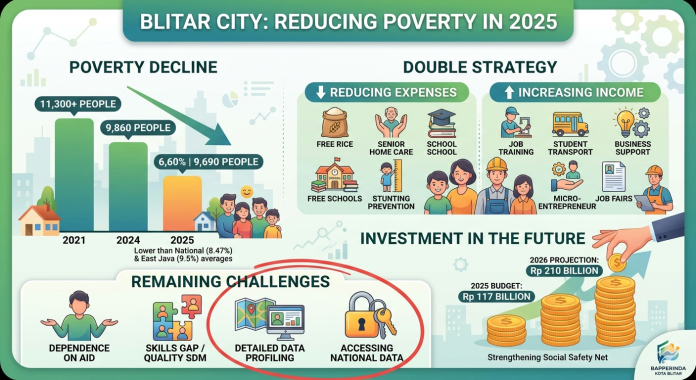

BLITAR – Blitar poverty rate dropped to 6.6 percent in 2025, showing progress in the city’s poverty reduction efforts despite several social and economic challenges.
Data from Indonesia’s Central Statistics Agency showed that around 9,690 residents in Blitar City still live below the poverty line this year. However, the figure remains lower than the national poverty rate of 8.47 percent and East Java’s rate of 9.5 percent.
Head of the Blitar City Regional Planning, Research, and Innovation Agency, Widodo Saptono Johannes, said the latest figures reflect the impact of government intervention programs.
“The numbers show that poverty continues to decline. In 2021, the figure reached more than 11,300 people. It gradually dropped to around 9,860 in 2024 and now stands at about 9,690 residents in 2025,” Widodo said.
According to him, the city government applies a dual strategy to tackle poverty. Officials focus on reducing household expenses while increasing income opportunities for residents.
To reduce living costs, the administration distributes subsidized rice assistance known as Rastrada. The city also provides free schools, elderly home-care services, and stunting prevention programs.
Local authorities continue supporting economic empowerment programs as well. Officials provide entrepreneurship training, job fair facilitation, and free transportation services for students.
Widodo said the city plans to strengthen those programs with larger financial support next year. Based on Bapperinda data, Blitar City could allocate around Rp 210 billion for poverty reduction programs in 2026.
The projected budget marks a major increase compared with the Rp 117 billion allocated in 2025. This year, the government reserved around Rp 114 billion specifically to reduce public spending burdens among vulnerable residents.
“We want to strengthen the social safety net so government intervention can directly help vulnerable residents,” he explained.
Despite the positive trend, the city still faces several structural challenges. Officials continue struggling to complete detailed poverty data in many neighborhoods.
The administration also seeks broader access to the National Integrated Social and Economic Data system, known as DTSEN. The effort follows Presidential Instruction No. 4 of 2025.
Widodo added that sociological problems remain another challenge. Some residents still depend heavily on social assistance programs.
Unequal human resource quality also limits access to decent employment opportunities. The city government now aims to improve workforce competitiveness through training and empowerment programs.
“Our target is to continue lowering poverty through spending reduction programs and income improvement strategies,” he said.