
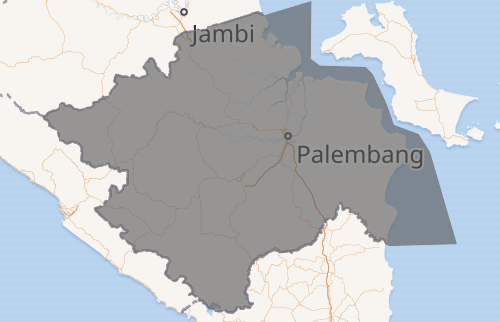

RADAR TULUNGAGUNG – South Sumatra, one of Indonesia’s most historically significant provinces, has evolved from the former heartland of the Sriwijaya maritime empire into a modern administrative region consisting of 13 regencies and four cities. The province continues to play a major role in the national economy through its abundant natural resources, strategic location, and growing regional development.
Known as the “Land of Sriwijaya,” South Sumatra occupies a prominent place in Indonesian history. The province is home to Palembang, the former center of the Sriwijaya Kingdom, which dominated maritime trade routes across Southeast Asia between the seventh and 13th centuries.
Today, South Sumatra remains one of Indonesia’s key resource-producing regions, with significant reserves of petroleum, natural gas, and coal. The province also serves as an important transportation and commercial hub in southern Sumatra.
The Historical Formation of South Sumatra
South Sumatra was formally established as a separate province on September 12, 1950, with Palembang designated as its capital. The city’s selection reflected its historical importance as the seat of the Sriwijaya Kingdom and its strategic position along the Musi River, one of Sumatra’s most important waterways.
Before becoming an independent province, the region formed part of the larger Sumatra administrative structure during both the Dutch colonial era and the early years of Indonesian independence.
At the time of its establishment, South Sumatra encompassed a much larger territory, including areas that later became the provinces of Lampung, Bengkulu, and the Bangka Belitung Islands. Over subsequent decades, administrative restructuring led to the creation of new provinces and districts, gradually reducing South Sumatra to its current boundaries.
The province now covers approximately 91,592 square kilometers and has a population of around 8.8 million residents, making it one of the most populous provinces on the island of Sumatra.
Regional Expansion Shaped the Modern Province
A major factor behind South Sumatra’s modern administrative structure has been regional expansion, known locally as pemekaran. The policy aimed to improve public services, strengthen local governance, and accelerate economic development.
Several new regencies and autonomous cities emerged through this process. Ogan Komering Ulu, for example, was divided in 2003 to create Ogan Komering Ulu Selatan and Ogan Komering Ulu Timur. Ogan Komering Ilir later gave rise to Ogan Ilir, while Muara Enim contributed territory for the creation of Penukal Abab Lematang Ilir and the autonomous city of Prabumulih.
Similarly, Lahat Regency became the parent region for Pagar Alam and Empat Lawang, while Musi Rawas was divided to form Musi Rawas Utara. Musi Banyuasin also contributed territory to the establishment of Banyuasin Regency.
As a result of these administrative changes, South Sumatra currently consists of 13 regencies and four cities, including Palembang, Lubuklinggau, Pagar Alam, and Prabumulih.
Sriwijaya Heritage and Economic Importance
South Sumatra continues to preserve its connection to the Sriwijaya Empire, which controlled major maritime trade routes across Southeast Asia for centuries.
One of the province’s most recognizable landmarks is the Ampera Bridge in Palembang. Engineers completed the bridge in 1965 with Japanese war-reparation assistance. The structure connects the Seberang Ulu and Seberang Ilir areas across the Musi River and remains a symbol of South Sumatra’s modernization.
The province also boasts Lake Ranau, the second-largest lake on Sumatra after Lake Toba. Volcanic activity created the lake thousands of years ago near the border between South Sumatra and Lampung. Today, the area attracts visitors with its natural scenery and tourism potential.
Meanwhile, Muara Enim and Musi Banyuasin continue to support the provincial economy through mining and energy production. Their resource wealth complements Palembang’s role as the administrative, commercial, and cultural center of South Sumatra.
South Sumatra’s journey from the heart of the Sriwijaya Empire to a modern province illustrates how historical heritage and regional development can advance together. Through administrative reforms, economic growth, and cultural preservation, the province continues to strengthen its position as one of Indonesia’s most influential regions.