
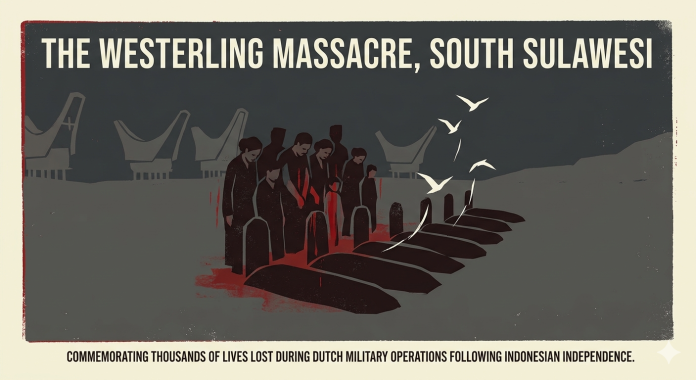

RADAR TULUNGAGUNG – The Westerling Massacre in South Sulawesi remains one of the darkest chapters in Indonesia’s struggle for independence, as Dutch troops killed thousands of civilians during military operations between 1946 and 1947. Dutch commander Raymond Westerling led the campaign, which initially targeted suspected republican fighters before expanding into mass executions and terror against local communities.
The violence erupted after the Netherlands tried to regain control of Indonesia following the country’s declaration of independence on August 17, 1945. South Sulawesi quickly became a center of resistance as local fighters and civilian militias launched guerrilla attacks against Dutch military positions in Makassar, Gowa, and nearby regions. In response, Dutch authorities deployed elite anti-guerrilla troops under Westerling, who had already gained a reputation for ruthless military tactics.
Historical investigations and survivor testimonies later revealed how Dutch forces surrounded villages, forced civilians into open fields at gunpoint, and executed suspected resistance members without trial. Official inquiries estimated that the operations killed between 3,000 and 4,000 people, making the Westerling Massacre one of the deadliest colonial-era atrocities in modern Indonesian history.
Dutch Attempts to Reclaim Indonesia Triggered Armed Resistance
After Indonesia declared independence in 1945, Dutch authorities returned alongside British Allied troops under AFNEI. The Dutch used NICA to restore their political influence and pushed plans to establish federal states across the archipelago. Many Indonesians believed the strategy aimed to weaken the republic and divide the independence movement.
People across the country responded with armed resistance, including fighters in South Sulawesi. One of the most active groups, Lapris, carried out guerrilla attacks on Dutch military posts, communication lines, and logistics centers. Fighters often launched surprise raids at night before retreating into villages and forests.
The resistance alarmed Dutch officials because Makassar held strategic importance for Dutch influence in eastern Indonesia. Dutch commanders feared they could lose control of the region if local fighters strengthened their positions.
To suppress the resistance, Dutch military leaders deployed Depot Speciale Troepen (DST), an elite anti-guerrilla force under Westerling’s command. Before arriving in South Sulawesi, Westerling had already served in World War II and gained experience in counterinsurgency warfare.
Dutch Troops Carried Out Executions Across South Sulawesi
On December 12, 1946, DST forces launched coordinated operations in villages near Makassar, including Batua, Borong, and Patu Nolang. Soldiers stormed homes before dawn, dragged residents into open areas, and forced thousands of civilians to gather under armed guard.
According to survivor accounts, Westerling read out the names of dozens of suspected resistance members in Batua before ordering his troops to shoot them. Panic spread immediately after the executions began. Some civilians tried to flee, but Dutch soldiers fired directly into the crowd.
The killings quickly spread beyond Makassar. DST troops repeated the same pattern in Gowa, Takalar, Jeneponto, Polongbangkeng, and Mandar. Soldiers surrounded villages, separated suspected fighters from civilians, and carried out public executions to intimidate local residents.
In Mandar, local fighters reportedly killed two DST soldiers during clashes with Dutch forces. Westerling’s troops responded with overwhelming force and killed hundreds of people in retaliation. Historical estimates cited in investigations placed the death toll in Mandar at around 364 people.
Dutch authorities later declared a military emergency, known as noodtoestand, in South Sulawesi on January 6, 1947. The policy gave Dutch troops broad authority to arrest, interrogate, and execute suspected opponents without civilian oversight.
Local Kings and Resistance Fighters Continued the Struggle
Despite the violence, resistance leaders in South Sulawesi continued fighting Dutch forces. Several local rulers supported the independence movement, including Raja Bone ke-31 Andi Mappanyukki and Andi Abdullah Bau Massepe from the Kingdom of Suppa.
Bau Massepe personally led guerrilla operations against Dutch military targets in Gowa. His forces attacked supply depots, sabotaged communication networks, and disrupted Dutch troop movements across the region.
Dutch intelligence agents eventually tracked his movements and helped DST forces capture him. On February 2, 1947, Dutch troops executed Bau Massepe publicly in front of local residents. The execution triggered fresh clashes as angry civilians and resistance fighters launched new attacks against Dutch forces.
Westerling’s troops answered the resistance with more violence. Soldiers opened fire on crowds, burned villages, and buried victims in mass graves. The military campaign continued until March 23, 1947, when Dutch authorities withdrew DST forces from South Sulawesi.
International Criticism Followed the Military Campaign
Reports from journalists, missionaries, medical workers, and surviving witnesses eventually exposed the scale of the killings. Critics accused Westerling and Dutch authorities of carrying out war crimes and crimes against humanity in South Sulawesi.
Dutch investigators questioned Westerling in 1947, but he denied ordering unlawful killings. He claimed his troops only executed criminals and armed rebels. Dutch colonial courts later cleared him of wrongdoing, despite testimony from survivors who directly linked him to the shootings.
The controversy continued for decades before the Dutch government officially acknowledged the atrocities in 2013. Authorities recognized the operations as serious human rights violations and offered compensation to several widows of victims after legal action supported by Komite Utang Kehormatan Belanda (KUKB).
The Westerling Massacre still shapes historical memory in Indonesia, especially in South Sulawesi, where many families continue to remember the violence that devastated villages during the fight for independence.