

RADAR TULUNGAGUNG – For decades, many villages across Indonesia have felt trapped in a rigid development system. Funds arrived from the central government, programs followed thick bureaucratic manuals, and village officials simply executed orders without creating meaningful change. Now, a growing discussion around the KDMP Civic Cooperative model is challenging that old approach and offering a new vision for village sovereignty.
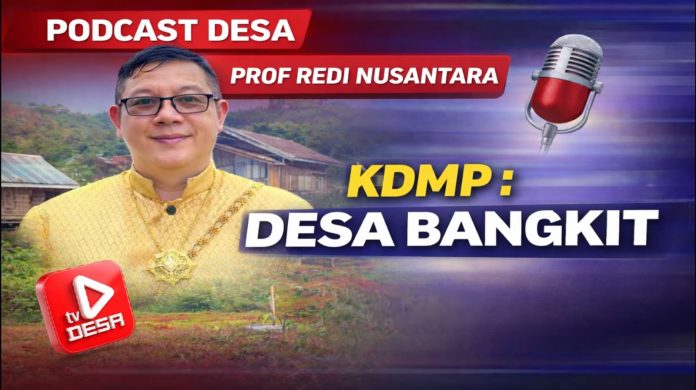
The concept of KDMP, short for Koperasi Desa Merah Putih (Merah Putih Village Cooperatives), emerged as the main topic in a recent Podcast Desa discussion by TV Desa. The podcast dissected a foreword written by Prof. Dr. Ir. Redi Nusantara, M.M., who described the cooperative movement as more than just an economic institution. According to the discussion, the KDMP Civic Cooperative model could become a powerful tool to restore local control over village economies and rebuild the spirit of collective participation.
The conversation immediately highlighted a harsh reality. Villages in Indonesia often become objects of development projects instead of active decision-makers. Although villages form the backbone of the country’s social and economic structure, modernization policies frequently place rural communities at the back of the national agenda.
Commercialization Threatens Village Sovereignty
Prof. Redi argued that commercialization and aggressive market liberalization have gradually weakened village independence. Productive lands once managed collectively by local communities are increasingly controlled by large corporations for monoculture plantations and industrial projects.
As a result, villagers who previously managed their own resources now work merely as laborers on their ancestral land. Social relationships that once relied on mutual cooperation slowly shift into purely transactional interactions.
The KDMP Civic Cooperative model aims to reverse that trend. Instead of functioning as a simple savings-and-loan institution, the cooperative is designed as a “civic cooperative” that combines economic empowerment, citizen participation, and the regeneration of gotong royong values.
According to the podcast, the concept transforms cooperatives into social fortresses capable of protecting villages from economic shocks such as fertilizer crises, inflation, and unstable commodity prices.
KDMP Seen as a Social Shock Absorber
The discussion explained how KDMP could strengthen farmers’ bargaining positions during harvest seasons. Instead of competing individually and depending on middlemen, villagers would consolidate their resources through the cooperative.
The cooperative could absorb agricultural products at fair prices, process them for added value, and distribute them more efficiently. This system allows villages to maintain greater economic control while protecting residents from market instability.
Prof. Redi described the cooperative as a “social fortress” that absorbs economic pressure before it destroys local communities. The approach also revives the meaning of gotong royong by encouraging villagers to share risks and collectively manage resources.
Village Facilitators Become Key Players
Another major focus of the discussion involved the role of TPP, or professional village facilitators. Unlike traditional bureaucratic officers who simply complete administrative paperwork, facilitators in the KDMP ecosystem are expected to become local problem-solvers and guardians of village solidarity.
Interestingly, the podcast highlighted that many facilitators openly documented failures instead of producing flattering reports. Some cooperative projects reportedly collapsed due to local elite conflicts, poor business planning, or public distrust.
However, these failures became valuable lessons. Facilitators continued mediating disputes, rebuilding community trust, and redesigning cooperative strategies based on local realities.
The podcast described this honesty as a rare breakthrough in Indonesia’s development culture, where many reports traditionally prioritize pleasing superiors instead of revealing actual field conditions.
From “Supervisor” to “Partner”
One of the strongest ideas discussed in the program involved changing the government’s role in village development. Prof. Redi stated that KDMP can only grow effectively when the state acts as a partner rather than a supervisor.
For years, development policies often relied on top-down approaches. Central authorities created rigid blueprints, while villages merely followed instructions. Under the partnership approach, however, the government would sit together with villagers, identify local potential, and remove regulatory barriers without taking over community leadership.
The discussion also emphasized the role of Kode Indonesia, a village community cooperative network that aggregates grassroots innovation and brings village voices into national policymaking discussions.
Prof. Redi even recommended that the empirical experiences documented in the KDMP movement should reach President Prabowo Subianto directly. He argued that policymakers need to understand the real struggles faced by villagers instead of relying solely on statistics and bureaucratic indicators.
Villages Encouraged to Build Context-Based Innovation
Toward the end of the podcast, the speakers outlined three major calls to action. First, villages must continue building innovation based on local context instead of copying trends from other regions.
A tourism project successful in one village may completely fail elsewhere because every village has different social, economic, and geographical characteristics. The KDMP approach encourages communities to treat cooperatives as experimental laboratories tailored to local needs.
Second, facilitators must strengthen solidarity networks to avoid burnout and isolation while handling local conflicts and bureaucratic pressure.
Third, the KDMP documentation itself should become a discussion tool in village forums, academic spaces, and development meetings. Rather than collecting dust on office shelves, the book should provoke debate about how villages can reclaim economic sovereignty and redefine development from the grassroots level.
The podcast concluded with a powerful message: true development does not come from luxurious offices in the capital city. Real transformation grows from village soil, collective participation, and the courage of local communities to shape their own future.