
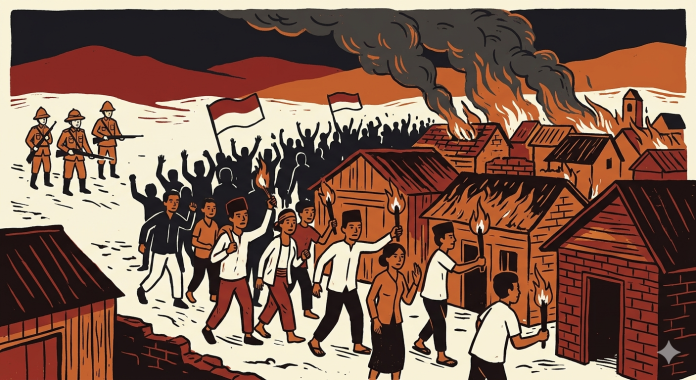

RADAR TULUNGAGUNG – Bandung Sea of Fire history stands as one of the most dramatic and emotional chapters in Indonesia’s struggle for independence. More than just a battle, it was a collective sacrifice that saw an entire city deliberately burned by its own people to prevent it from falling into enemy hands.
Bandung Sea of Fire history began shortly after Indonesia declared independence in August 1945. While the nation celebrated freedom, the Dutch refused to recognize it and sought to regain control. They returned under the cover of Allied Forces Netherlands East Indies (AFNEI), claiming to restore order and free prisoners of war.
However, suspicion quickly grew. Indonesian fighters and civilians realized that the Allied presence was not as neutral as it seemed. Dutch administrative forces, known as NICA, arrived alongside them, signaling a clear intention to re-establish colonial rule. Tensions escalated rapidly, particularly in Bandung, a strategic city in West Java.
Rising Tensions and Ultimatums
Bandung Sea of Fire history intensified when Allied troops issued ultimatums demanding that Indonesian fighters surrender their weapons and evacuate parts of the city. Bandung was divided into northern and southern zones, with the Allies controlling the north.
On November 21, 1945, the first ultimatum required Indonesian forces to leave North Bandung. This sparked anger among locals, leading to clashes between Indonesian fighters and Allied troops. The situation worsened as former prisoners, now armed, began causing unrest in the city.
Despite resistance, a second and more severe ultimatum was issued on March 23, 1946. This time, all Indonesian forces and civilians were ordered to evacuate the entire city. Facing superior weaponry and to avoid massive civilian casualties, the central government instructed troops to withdraw.
The Decision to Burn Bandung
Reluctant to surrender Bandung without a fight, Indonesian leaders devised a bold strategy. Under the command of Colonel Abdul Haris Nasution, and supported by local resistance groups, a decision was made to implement a scorched-earth tactic.
The plan was simple yet devastating: if Bandung could not be defended, it would be destroyed so the enemy could not use it. This marked the turning point in the Bandung Sea of Fire history.
On the night of March 24, 1946, approximately 200,000 residents evacuated the city. As they left, Indonesian fighters and civilians set fire to homes, buildings, and key infrastructure. Flames engulfed Bandung for nearly seven hours, turning it into a massive sea of fire.
Remarkably, many residents burned their own homes voluntarily. Without direct orders, they chose sacrifice over surrender, carrying only essential belongings as they fled.
A City in Flames and Acts of Heroism
The destruction was widespread. Important areas such as Braga, Cicadas, and Tegalega were consumed by fire. Thick black smoke filled the sky, visible from miles away, symbolizing both loss and resistance.
Amid this chaos, stories of heroism emerged. One of the most notable figures in the Bandung Sea of Fire history was Mohammad Toha, a young fighter aged just 19. Determined to deal a significant blow to the enemy, he launched a daring mission to destroy an ammunition depot in Dayeuhkolot.
Despite being wounded during the operation, Toha successfully detonated explosives, destroying the facility. He died in the process, but his sacrifice became legendary, inspiring generations to come.
Legacy Beyond Destruction
The Bandung Sea of Fire history is remembered not only as a tragedy but also as a brilliant military strategy. Although Indonesian forces were outmatched in weapons and numbers, they demonstrated resilience, unity, and determination.
Even after the city was abandoned, guerrilla warfare continued from surrounding areas. The spirit of resistance remained alive, proving that the struggle for independence did not end with the burning of Bandung.
The event also left a lasting cultural legacy. The iconic song “Halo-Halo Bandung,” composed by Ismail Marzuki, immortalized the spirit of the event. Today, monuments and historical sites continue to commemorate the sacrifice of Bandung’s people.
Ultimately, the Bandung Sea of Fire history serves as a powerful reminder that independence came at a great cost. It reflects the courage of ordinary citizens who chose to lose everything rather than live under colonial rule again.