
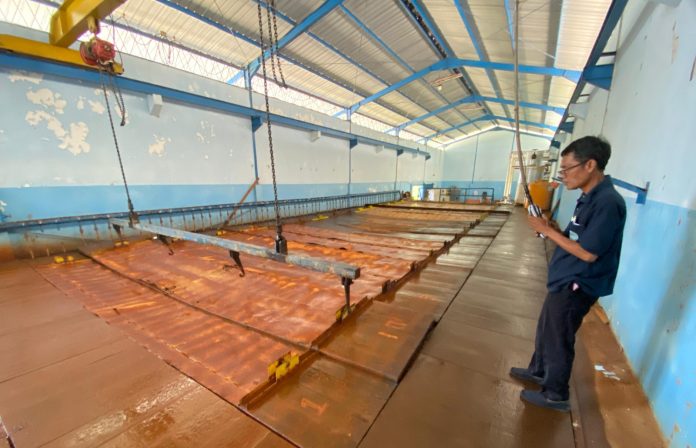

TRENGGALEK – Trenggalek ice factory production has dropped to around 50% of its capacity, even as demand from fishermen and fish processing industries remains high. The facility, operated by the region’s public enterprise (PDAU), now struggles to meet daily supply needs.
Cusi Kurniawati, Assistant for Economy and Development at the Trenggalek Regional Secretariat, said outdated machinery has caused the decline. The factory should produce up to 2,000 ice blocks per day. However, it now only delivers about 1,000 blocks.
“Current output stands at roughly 50% of capacity. We should reach 2,000 blocks daily, but we only produce around half of that,” she said.
She pointed to aging equipment as the main issue. In particular, damaged compressors and worn-out molds have slowed production and reduced efficiency. As a result, workers must repeat several stages in the process, which increases operational strain.
At the same time, operating costs remain unchanged. The factory still consumes the same level of electricity, even though production has declined significantly.
“The process takes longer and often requires repetition. That drives up electricity costs,” Cusi explained.
Meanwhile, demand for ice blocks in coastal areas such as Prigi continues to rise. Fishermen rely on a steady ice supply to preserve their catch, while fish processing businesses also depend on the facility.
“Demand remains consistently high. In fact, it tends to increase, but limited production prevents us from meeting it fully,” she added.
The production gap has started to affect the company’s revenue. High operating costs combined with reduced output have weakened the financial performance of the region-owned enterprise.
Despite the challenges, the local government still relies on the ice factory as the main income source for PDAU. So far, officials have not announced expansion plans or major upgrades for the facility.
However, Cusi stressed the need for innovation and improvement. She believes the factory has strong potential to grow if the government focuses on upgrading equipment and boosting efficiency.
“We hope to develop the ice factory into a healthier and profitable business. It should support operations and contribute to regional revenue,” she said.
The administration aims to turn the struggling unit into a sustainable asset. With proper investment and modernization, the ice factory could once again play a key role in supporting the local economy and increasing regional income.