
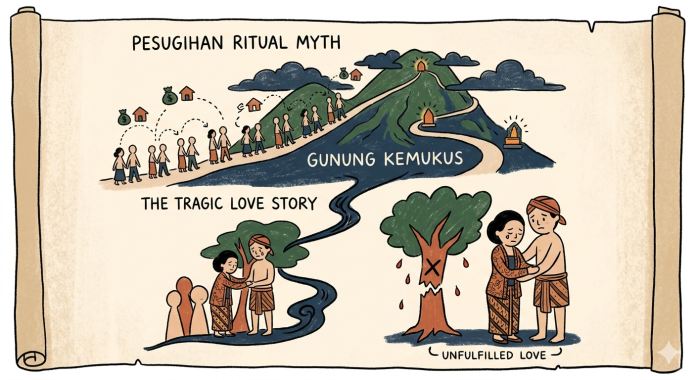

RADAR TULUNGAGUNG – The legend of Gunung Kemukus has long fascinated Indonesians because of its dark reputation tied to pesugihan rituals and forbidden myths. Behind the controversial story, however, lies a tragic tale involving Pangeran Samudro and Nyai Ontrowulan, two figures whose love story became distorted over centuries.
The story reportedly began during the collapse of the Majapahit Kingdom when political tensions spread across Java as power slowly shifted to the Demak Sultanate. Amid the uncertain transition, Pangeran Samudro emerged as a respected young nobleman known for his intelligence, politeness, and deep religious education.
Yet fate led the prince into a forbidden relationship that would eventually shape the myth of Gunung Kemukus pesugihan for generations.
Forbidden Love Inside the Palace
Life inside the royal palace was filled with strict rules and traditions. Pangeran Samudro often spent time alone reflecting on the kingdom’s future. During those quiet moments, he grew close to Nyai Ontrowulan, his stepmother and one of the king’s concubines.
Nyai Ontrowulan was admired throughout the palace for her extraordinary beauty and graceful personality. Initially, she treated the young prince like her own son. However, admiration slowly turned into affection, and the two eventually developed feelings for each other.
Their growing closeness soon transformed into a secret romance hidden from palace guards and royal servants. Although both understood that their relationship violated royal law and religious values, they continued meeting in secret areas of the palace garden.
The forbidden affair eventually sparked rumors among palace workers. Suspicion spread rapidly until it finally reached the ears of the king himself.
The King’s Wrath and Exile
One night, the king personally caught Pangeran Samudro and Nyai Ontrowulan together in the palace garden. Furious over the betrayal, he publicly condemned his son for tarnishing the family’s honor.
As punishment, the king stripped Pangeran Samudro of his royal title and ordered him to leave the kingdom forever. The prince accepted the punishment without resistance because he realized the seriousness of his actions.
Heartbroken, Pangeran Samudro left the palace alone and wandered westward through forests and remote villages. Meanwhile, Nyai Ontrowulan remained imprisoned inside the palace under strict guard.
Unable to bear the separation, Nyai Ontrowulan eventually escaped from the palace disguised as a servant. She followed the prince’s path through dangerous forests and rugged hills, determined to reunite with the man she loved.
The Origin of Gunung Kemukus
After days of searching, Nyai Ontrowulan finally found Pangeran Samudro resting weakly beneath a large tree on a lonely hill. Their emotional reunion became the beginning of a new life far away from the royal court.
The isolated hill where they hid later became known as Gunung Kemukus. For a brief moment, the couple lived peacefully together despite their difficult circumstances.
However, tragedy soon followed. Pangeran Samudro fell seriously ill due to exhaustion, hunger, and harsh environmental conditions. Nyai Ontrowulan desperately searched for herbs and traditional medicine, but his condition continued worsening.
As his final moments approached, the prince reportedly apologized for bringing suffering into Nyai Ontrowulan’s life. Shortly afterward, he died in her arms on the hilltop.
Consumed by grief, Nyai Ontrowulan refused to leave his grave. Villagers later discovered her mourning beside the burial site. Despite offers of help, she chose to remain near the prince’s tomb until illness eventually claimed her life as well.
The villagers buried Nyai Ontrowulan beside Pangeran Samudro, creating the twin graves that still exist today.
How the Pesugihan Myth Emerged
Over time, strange mist frequently appeared around the hilltop graves. Locals described the thick fog as resembling steaming smoke, or “kemukus” in Javanese. The phenomenon gave the hill its famous name.
As stories spread, many people began associating Gunung Kemukus with supernatural powers and spiritual energy. According to local legends, some interpreted Pangeran Samudro’s final message as an instruction for visitors to complete the unfinished love story between him and Nyai Ontrowulan.
This interpretation later evolved into the controversial Gunung Kemukus pesugihan ritual. Certain groups believed visitors could obtain wealth by performing immoral acts near the sacred graves.
The myth transformed the once-respected historical site into a controversial destination associated with mystical wealth-seeking practices, prostitution, and moral controversy.
Efforts to Restore Historical Truth
In recent years, historians and religious leaders have worked together to correct the narrative surrounding Gunung Kemukus. Research into ancient Javanese manuscripts suggests Pangeran Samudro was actually a religious figure traveling to spread Islamic teachings before his death.
Authorities have also reorganized the area, shutting down illegal activities and restoring the site as a religious and cultural heritage destination.
Today, Gunung Kemukus stands not only as a reminder of Indonesia’s mystical folklore but also as a warning about how history can be twisted by greed and misunderstanding. The tragic love story of Pangeran Samudro and Nyai Ontrowulan continues to survive, but many now hope it will be remembered as a tale of human tragedy rather than a symbol of pesugihan rituals.